Keeping a Garage Door Maintenance Log: What to Track and Why

Royal Garage Doors has customer feedback on its Etobicoke Google profile and technicians with hands-on experience installing and repairing doors across Toronto and the wider GTA.
What should you track in a garage door maintenance log?
Keeping a garage door maintenance log means writing down your door's install date, opener model and serial number, spring type, and the date and details of every repair or tune-up.
What's the minimum I should track for my garage door?
At minimum, write down the install date, the opener's model and serial number, and the date of every repair. Those three details cover most of what a warranty claim or
- Customer feedback
- Read our Google reviews (Etobicoke profile)
- Experience
- Garage door service across the GTA
- Repair warranty
- 1-year parts and labour unless a specific written warranty overrides it
- Author
- Royal Garage Doors, Garage door repair and installation
Why the most-used mechanical system in your house has no paperwork
Most homeowners can tell you roughly when the furnace was serviced or when the roof was redone. Ask the same person when their garage door springs were last replaced, and you'll usually get a shrug. That's backwards. The garage door is one of the only systems in the house that moves every single day, often more than once, and it does it while holding the full weight of the door on a wound spring and a set of cables under tension. It deserves at least as much of a paper trail as the furnace filter.
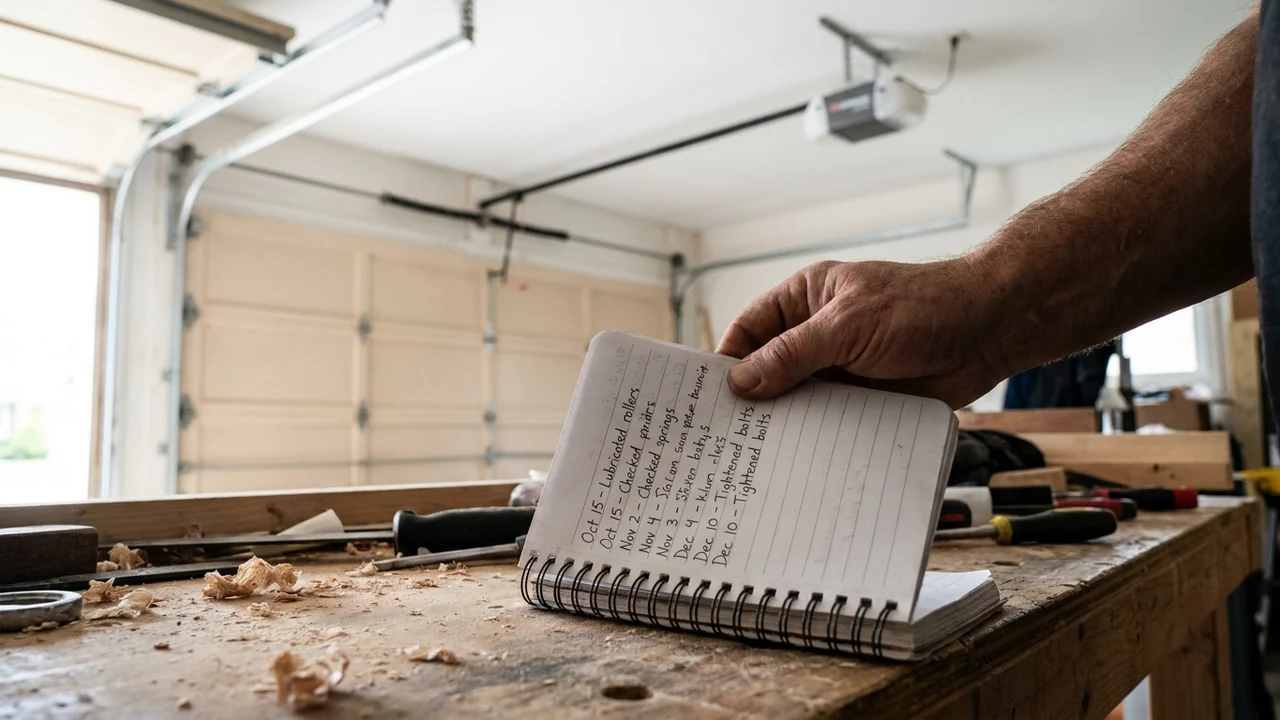
A maintenance log doesn't need to be complicated. It just needs to exist, and it needs to travel with the house — in a drawer, a phone note, or a folder next to your other home records — so that whoever needs it (you, a technician, a future buyer) can find it in thirty seconds instead of guessing.
The four things worth writing down the day it's installed
If you do nothing else, capture these before the installer's truck leaves the driveway:
- Install date — and whether it was a full door replacement, an opener-only swap, or both. This is the date every warranty clock starts from.
- Door details — size (8x7, 9x7, 15x7, 16x7, etc.), material, and colour. If a panel ever needs replacing, matching it is much faster with the original spec on hand.
- Opener details — make, model, and serial number, plus the drive type (chain, belt, or side-mount/jackshaft). This label is usually on the side of the motor housing, and after a few Ontario winters in an unheated garage it can fade to unreadable. Photograph it once and you'll never need to squint at it again.
- Spring type and size — torsion or extension, single or double. Springs are the part most likely to be replaced independently of the door itself, so their own install date matters as much as the door's.
Then log every visit, not just the big repairs
A tune-up that finds nothing wrong is still worth a line in the log — it's proof the door was inspected on schedule, and it gives the next technician a baseline to compare against. Keep it as simple as a running table:
| Date | What was done | Notes |
|---|---|---|
| 2024-06-14 | Door + opener installed | 16x7 double, belt-drive opener, serial on file |
| 2025-06-02 | Annual maintenance tune-up | Lubrication, balance check, sensor alignment — $120 |
| 2026-01-19 | Torsion spring replaced | Snapped in cold snap, single spring, $280, 3-tier warranty |
Three columns, one row per visit. That's the whole system — no spreadsheet formulas required.
How a log shortens a warranty claim
Royal Garage Doors installs carry a 1-year labour warranty, a 5-year hardware warranty, and a lifetime panel warranty against rust-through perforation. Spring repairs carry their own 3-tier warranty. All of that is tied to a date. When you call to ask whether a squeal or a sag is covered, the first question is going to be "when was this installed or last repaired?" If the answer is in your log instead of buried in an inbox somewhere, the office can confirm eligibility on that first call instead of putting you on hold while someone searches invoice history by address.
This matters most for hardware that fails months apart from unrelated causes — a roller at month 8, a sensor at month 14. Without dates, it's easy to lose track of which repair is still inside its window and which one has aged out.
How it helps a technician diagnose faster, before they even arrive
When you book a service call and can tell the technician the opener's model number, the drive type, and that this is the second gear kit in three years, they're not walking in blind. They can bring the part that's actually likely to be needed instead of doing a diagnostic-only visit and coming back a second time. A pattern of repeat repairs on the same opener also tells a different story than one isolated failure — it's the difference between "replace the gear kit again" and "this motor is past the point of being worth repairing," which is exactly the kind of call a technician can make faster with history in hand instead of starting from zero.
The same logic applies to springs. A technician who knows the door is a heavier insulated model, that the springs are original from a 2016 install, and that the door cycles multiple times a day can tell you it's close to end of life before it snaps and leaves the car trapped — rather than finding out only after an emergency call.
What it's worth when you sell the house
A garage door doesn't get the attention a kitchen or a roof does in a GTA listing, but it does get a line item on most home inspection reports — spring condition, opener age, track alignment. A buyer who sees "no service history" next to that line tends to assume the worst and treat it as a negotiating point. A folder with a couple of tune-up dates and a repair invoice or two doesn't need to be dramatic; it just needs to show the system was maintained on a normal schedule, which quietly removes that question before it gets asked.
A system simple enough you'll actually keep
The best maintenance log is the one that survives past the first entry. A few options that actually stick:
- A note in your phone — one entry per visit, dated, with the invoice photographed alongside it.
- The same binder as your other home records — furnace filter changes, roof work, water heater service. The garage door belongs in that stack, not off on its own.
- A card taped inside the garage near the opener or electrical panel — low-tech, but it's exactly where a technician will look first if you're not home.
Whichever format you pick, the habit that matters most is writing the entry the same day the work happens, while the invoice is still in your hand.
Royal Garage Doors recommendation
Every invoice Royal issues already has the date, the part, and the warranty terms on it — start your log by simply keeping those in one place, then add a line each time you book a $120 annual maintenance visit. If you're not sure when your springs or opener were last serviced, that's a normal starting point too; a technician can note the current condition on the first visit and you can build the log forward from there. See current rates on our pricing page, or book a maintenance visit and start the paper trail today.
Related reading: What Happens During a Royal Garage Doors Maintenance Visit.
Frequently Asked Questions
What's the minimum I should track for my garage door?
At minimum, write down the install date, the opener's model and serial number, and the date of every repair. Those three details cover most of what a warranty claim or a future technician will ask for.
Where should I find my opener's serial number?
It's on a label on the side or back of the motor unit, usually near the light bulb housing. In an unheated Ontario garage that label can fade or peel within a few winters, so it's worth photographing it once and saving the photo rather than relying on being able to read it years later.
Does Royal Garage Doors keep my service history on file?
Yes, every invoice is tied to your address and phone number, so past visits can be looked up. But having your own copy speeds things up, especially if you're calling about a warranty issue and want the technician to know what was done before they arrive.
How often should there be an entry in the log?
At least once a year, from a $120 maintenance tune-up, plus any repair visit in between. A door that's only ever logged when something breaks is missing the inspection history that catches a problem before it strands the car in the driveway.
Does a maintenance log actually matter when selling a house?
It won't make or break a sale, but it removes a question mark. A buyer or their home inspector who sees a door with no service history tends to assume the worst about the springs and opener; a folder with tune-up dates and repair records answers that before it's asked.
Sources & standards: Garage door safety follows the UL 325 standard for automatic operators. For safe manual operation, see Chamberlain's emergency-release guidance. Pricing reflects current Royal Garage Doors rates for the GTA.
The bottom line: done right, the result is a garage door that opens quietly, balances correctly and is safe to use every day — backed by Royal's 1-year labour warranty so the outcome lasts.