Garage Door Maintenance for a Newly Purchased Older Home

Royal Garage Doors has customer feedback on its Etobicoke Google profile and technicians with hands-on experience installing and repairing doors across Toronto and the wider GTA.
What should you check on a garage door when you buy an older home?
Garage door maintenance for a newly purchased older GTA home should start with a spring balance test and an auto-reverse safety check in your first few weeks — most home inspections skip both.
Do Ontario home inspectors test the garage door during a home inspection?
Most home inspectors check that the door opens, closes, and isn't visibly damaged, but a standard visual home inspection typically doesn't include a spring balance test or an auto-reverse safety
- Customer feedback
- Read our Google reviews (Etobicoke profile)
- Experience
- Garage door service across the GTA
- Repair warranty
- 1-year parts and labour unless a specific written warranty overrides it
- Author
- Royal Garage Doors, Garage door repair and installation
Why the home inspection didn't tell you much about the garage door
Most Ontario home inspection reports say something like "garage door opens and closes, no visible damage" and move on. That's not the inspector being careless — a standard visual home inspection isn't scoped to include a spring balance test or an auto-reverse safety test, which are the two checks that actually catch a worn spring or a sensor that won't stop the door on an obstruction. If you bought an older home anywhere from Mississauga's Streetsville to a 1970s bungalow in Etobicoke, the garage door's real service history is usually a blank page, even if the inspection report looked clean.
That's fine — it just means the first few weeks in the house are your chance to build a baseline instead of finding out the hard way in January.
Run these two safety tests before you use the door daily
Both take under five minutes and need no tools.
- Auto-reverse test: lay a piece of wood — a 2x4 flat on the floor works — where the door closes. Close the door normally. It should reverse the instant it touches the wood. If it keeps closing (or closes on the wood at all), stop using the opener until it's looked at. This is a documented safety hazard, not a quirk to live with, and it usually means the sensors or the opener's force settings need attention.
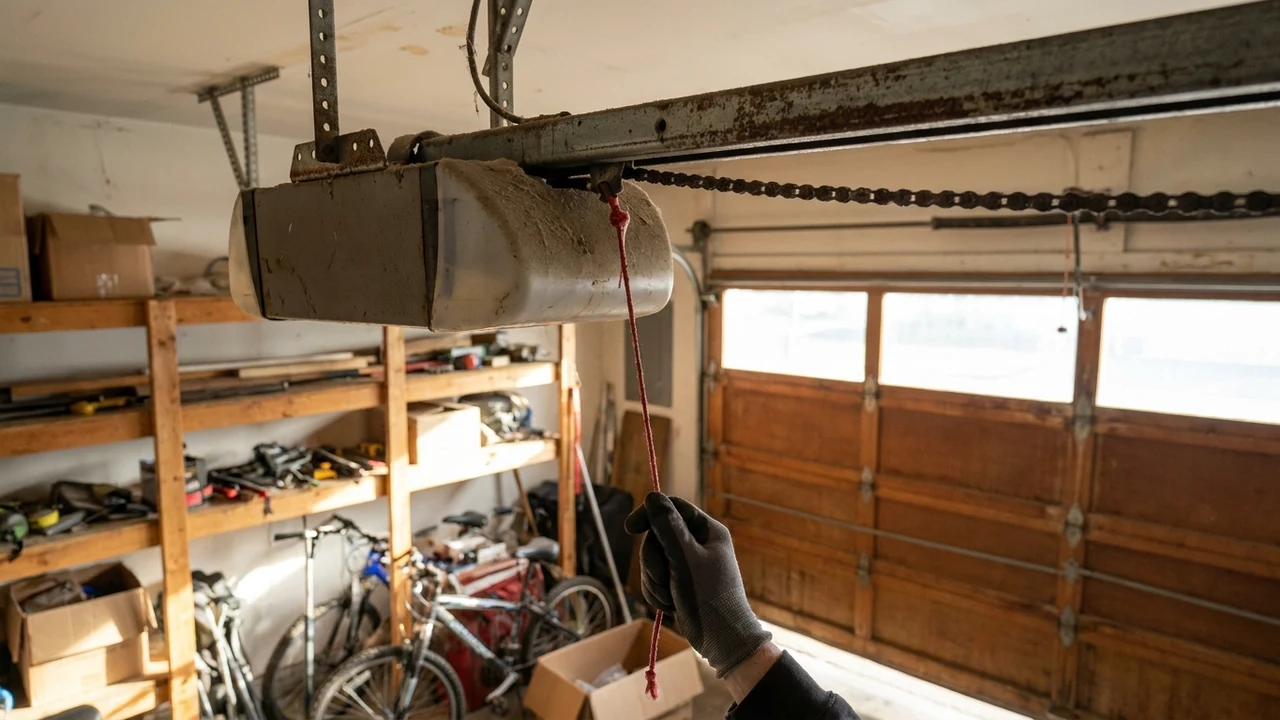
- Balance test: pull the manual release cord (the red handle hanging from the opener rail) to disconnect the door from the opener, then lift the door by hand about halfway. A properly balanced door stays roughly where you let go. If it drops back down or shoots upward, the spring tension is off — worn springs, not the opener, are almost always the cause.
If either test fails, don't try to compensate by adjusting the opener's force setting higher — that masks the problem instead of fixing it and puts more strain on the motor and gears.
Springs don't care how old the house is — they're rated in cycles
This is the part most new owners get wrong: a garage door spring's lifespan is engineered around a number of open-and-close cycles, not a number of years. A door that gets used heavily — two vehicles, a home office, kids in and out — can wear through a spring in a handful of years. A door in a rarely used detached garage can sit for well over a decade on the original spring and still test fine. The house's age tells you almost nothing on its own.
What does tell you something: look at the spring itself (it's the coil above the door, either one long spring in the center or two shorter ones). Rust along the coils, gaps that look uneven when the door is closed, or a spring that looks stretched out and slack rather than tightly wound are all signs of age catching up with it. Combined with a failed balance test, that's enough reason to have it replaced rather than wait for it to snap. A single torsion spring runs $280; a double spring setup (both springs replaced and rebalanced) is $320–$460.
Check the opener's age before you decide to fix it
Look inside the motor unit housing for a manufacture date sticker — most major brands (LiftMaster, Chamberlain, Genie) print one near the model and serial number plate on the side or bottom of the unit. If it's worn off or was never there, check for the external safety sensors instead: the two small units mounted a few inches off the floor on each side of the track. Those sensors have been a standard safety feature on residential openers since the early 1990s. An opener with no external sensors at all predates decades of safety design and is a strong signal to replace rather than repair, regardless of what else looks fine.
Opener repairs (gear kits, logic boards, remotes, capacitors) run $120–$550 depending on what's wrong. As a rule of thumb: if the repair quote is creeping up toward half of what a new opener costs, replace it instead of patching an old unit that'll likely need something else within a year or two. New openers, supplied and installed with programming, start at $600 for chain drive, $630 for belt-drive DC, and $760–$1,200 for smart/myQ-enabled units.
Look over cables, rollers, brackets, and track while you're in there
These are the parts a general home inspector is least likely to flag, because wear here doesn't always stop the door from opening — it just makes it louder, rougher, or less safe over time. Walk the track on both sides and check for:
- Frayed or rusted cables at the bottom brackets — these carry real tension and shouldn't be ignored if you see individual strands separating.
- Cracked, flat-sided, or noisy rollers — nylon rollers wear down and metal rollers can seize, both showing up as grinding or slamming as the door moves.
- Track alignment — older homes on the clay-heavy soil common across Mississauga, Brampton, and parts of Vaughan often settle unevenly over the decades, especially where a garage was added on or built with a slightly different foundation than the main house. A track that's pulled slightly out of parallel puts extra load on the rollers and opener.
Cables and brackets run $180–$260 to replace, rollers $120–$220, and track repair or realignment $180–$350. If the door has actually jumped the track, off-track repair is $180–$450 — get it looked at before running the opener again, since forcing a door back onto a bent track usually makes the bend worse.
Reseal the door before your first winter in the house
Weatherstripping is cheap, it's easy to overlook, and it's one of the most common things to find degraded in an older, unheated detached garage. UV exposure cracks the bottom seal over years, and in older Ontario garages it's not unusual to find sections chewed through by mice or squirrels looking for a way in over a previous winter. A gapped seal doesn't just let cold air in — it's an open invitation for pests before your first winter in the house. Bottom seal and side seal replacement, depending on door size, runs $120–$260.
When repair stops making sense
Deferred maintenance on a garage door tends to show up as a cluster, not one clean problem — a home you've just bought might need a spring, a couple of rollers, and new weatherstripping all in the same visit. Individually, none of that is expensive. But if you're looking at an opener past the 15–20 year mark with no safety sensors, a spring that's failed its balance test, and cosmetic panel damage (panel replacement runs $500–$1,000) all at once, it's worth stepping back and asking whether you're maintaining an aging system piece by piece or slowly rebuilding it anyway. There's no fixed dollar threshold — it comes down to whether the individual repairs are keeping a sound door running, or postponing a replacement you're going to need in a year regardless.
Royal Garage Doors recommendation
For a newly purchased older home, don't guess — get a baseline. A standard maintenance visit ($120) covers lubrication, a full balance check, safety sensor alignment, and hardware tightening, and gives you a written starting point for a door with unknown history instead of waiting to find out what's wrong the hard way. We're a garage door service company with customer feedback on our Etobicoke Google profile and experience serving the GTA, and every repair carries a warranty even when it turns out the previous owner never touched the thing.
See current rates for springs, openers, and hardware on our full pricing page, or book a maintenance visit — the service call is free with any repair.
Related reading: Your First Garage Door Checklist After Moving Into a GTA Home.
Frequently Asked Questions
Do Ontario home inspectors test the garage door during a home inspection?
Most home inspectors check that the door opens, closes, and isn't visibly damaged, but a standard visual home inspection typically doesn't include a spring balance test or an auto-reverse safety test — the two checks that actually catch a worn spring or a sensor that won't stop the door on an obstruction. Treat "the garage door works" on your inspection report as basic function confirmed, not a safety clearance.
How do I know how old the garage door opener is if I don't have the manual?
Look for a manufacture date sticker inside the motor unit housing, usually near the model and serial number plate — most major brands (LiftMaster, Chamberlain, Genie) print one. If there's no sticker, check whether the door has external photo-eye safety sensors mounted near the floor on each side of the track; an opener with none at all predates decades of standard safety design.
Is it safe to keep using an older garage door spring if I don't know when it was last replaced?
Run the balance test first — disconnect the opener, lift the door halfway by hand, and see if it holds position. If it drops or shoots up, the spring is out of balance and should be looked at before you use the opener regularly, since a worn spring puts extra strain on the motor and gears. A single torsion spring replacement runs $280; a double spring setup is $320-$460.
Should I repair or replace an old garage door opener in a newly purchased house?
If the opener is missing external safety sensors, shows no manufacture date within the last 10-15 years, or a repair quote (opener repairs run $120-$550) is approaching half the cost of a new unit, replacement usually makes more sense than continuing to patch it. A new chain-drive opener starts at $600 and a belt-drive DC unit from $630, both supplied and installed with programming.
What's included in a garage door maintenance visit for a newly purchased home?
A standard maintenance visit covers lubrication of moving parts, a spring balance check, safety sensor alignment, and tightening of hardware like hinges, brackets, and track bolts, for a flat $120. It gives you a documented starting point for a door with unknown service history — anything it finds, like frayed cables or a misaligned track, gets quoted separately.
Sources & standards: Garage door safety follows the UL 325 standard for automatic operators. For safe manual operation, see Chamberlain's emergency-release guidance. Pricing reflects current Royal Garage Doors rates for the GTA.
The bottom line: done right, the result is a garage door that opens quietly, balances correctly and is safe to use every day — backed by Royal's 1-year labour warranty so the outcome lasts.