Garage Door Opener Runs But the Door Doesn't Move

Royal Garage Doors has customer feedback on its Etobicoke Google profile and technicians with hands-on experience installing and repairing doors across Toronto and the wider GTA.
Why does my garage door opener run but the door won't move?
When a garage door opener runs but the door doesn't move, the trolley has almost always disconnected from the carriage — either the manual release was pulled or the drive gear, belt, or chain has failed. Royal Garage Doors sees this most often after a manual release accident; opener repair runs $120–$550 depending on the part.
Why is my garage door opener motor running but the door isn't moving?
In almost every case the trolley — the part that rides the rail and pulls the door — has disconnected from the drive mechanism, either because the manual release cord
- Customer feedback
- Read our Google reviews (Etobicoke profile)
- Experience
- Garage door service across the GTA
- Repair warranty
- 1-year parts and labour unless a specific written warranty overrides it
- Author
- Royal Garage Doors, Garage door repair and installation
When a garage door opener runs but the door doesn't move, the trolley has almost always disconnected from the carriage — either the manual release was pulled or the drive gear, belt, or chain has failed. Royal Garage Doors sees this most often after a manual release accident; opener repair runs $120–$550 depending on the part.
Check the trolley first — the manual release is the most common cause
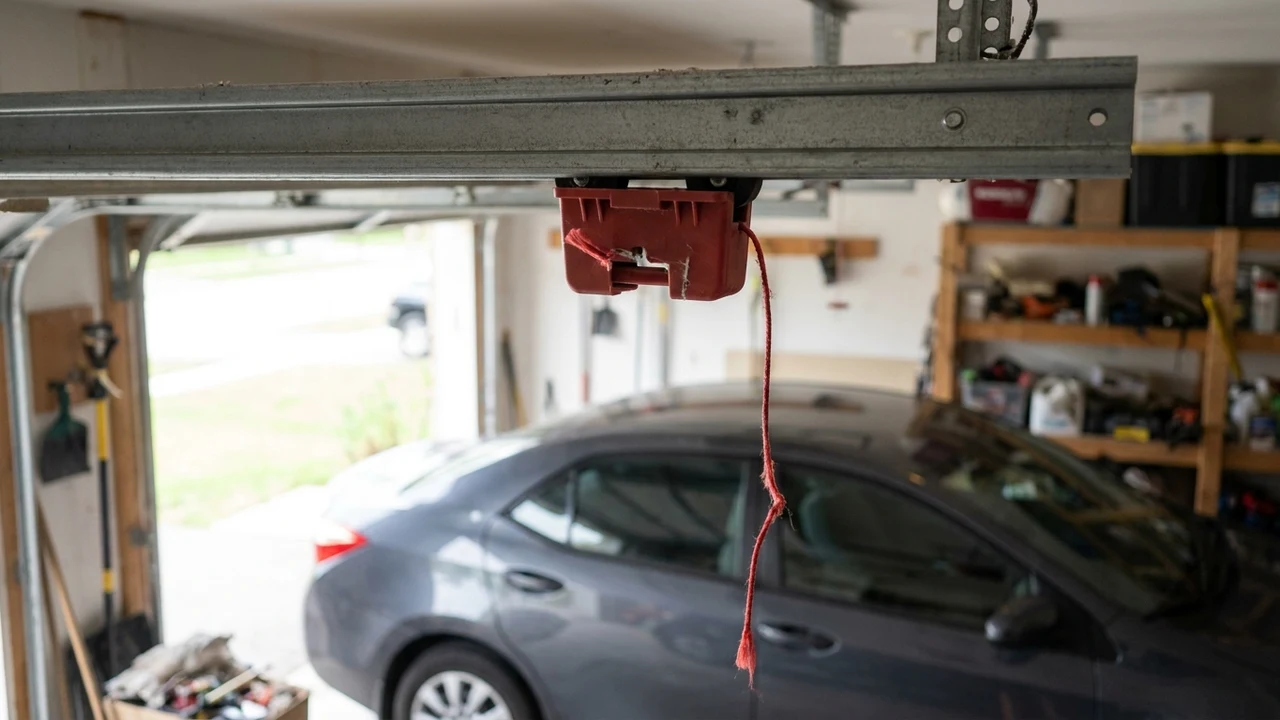
The trolley is the small carriage that rides inside the opener's rail and pulls the door open through an arm connected to the top panel. Every opener has a red cord hanging from the trolley — pull it, and the trolley disengages from the belt, chain, or screw drive so you can lift the door by hand during a power outage. That cord gets snagged more often than people expect: a roof rack, a stored ladder, a kid swinging on it. Once it's pulled, the motor still runs on command, the sprocket or belt still moves, but nothing is connected to the door.
Look up at the rail while someone presses the opener button. If the trolley sits still while the chain or belt moves past it, that's your answer. Reconnecting it usually means closing the door fully by hand first, then following your opener's release mechanism — on most LiftMaster and Chamberlain units, that's pulling the cord toward the motor head or running the opener until the trolley clicks back into the carriage. If the door doesn't move smoothly by hand before you try to reconnect anything, stop — that points to a spring problem, not a trolley problem, and forcing it is how people get hurt.
What the motor's sound is telling you
Before you climb a ladder, listen for a few seconds:
- Smooth hum, no strain, no resistance at all: the trolley is disconnected. The motor is spinning the drive mechanism freely with nothing attached to the door.
- Grinding, clicking, or a high-pitched whine: the drive gear inside the motor housing has stripped. This is the single most common mechanical cause of this exact symptom.
- A metallic slapping or rattling from inside the rail: a chain has come off its sprocket or a belt has slipped its pulley.
- The motor strains, sounds like it's working hard, then reverses or stops: that's not a disconnected trolley — that's the opener meeting real resistance, which usually means the door itself is the problem.
The drive gear is built to fail before your motor does
Inside almost every chain-drive and screw-drive opener, the motor turns a small nylon gear before power reaches the sprocket or drive screw. That gear is intentionally the weakest link — it's cheaper and safer for it to strip than for the motor to burn out or for the whole unit to lock up under load. After years of use, especially on older units that have never been serviced, that gear wears down and eventually strips its teeth. When it goes, the motor spins with zero resistance and the door doesn't move at all, even though everything sounds "on." GTA winters make this worse — nylon gets more brittle in the cold, and a lot of these failures show up on the first hard cold snap of the season when an opener that's been marginal all fall finally gives out.
Chain, belt, and side-mount drives fail a little differently
The general symptom is the same across drive types, but the specific failure point varies:
- Chain drive: the chain can snap, stretch until it jumps the sprocket, or derail from the rail entirely. You'll usually hear a distinct rattle or a slack chain slapping the inside of the rail.
- Belt drive: belts rarely snap outright, but they can slip off the drive pulley if a tensioner has loosened. The motor runs unusually quiet since there's no chain noise at all — just a smooth hum with nothing happening.
- Side-mount (jackshaft) openers: these drive the torsion bar directly rather than a trolley on a rail, so this exact symptom usually points to a slipped drive coupler or a stripped gear at the motor head instead of a trolley issue.
Make sure it isn't the door, not the opener
Once you've disengaged the trolley (or confirmed it's already disconnected), try lifting the door by hand, slowly, with two hands. A properly balanced door should lift with light, even effort and stay roughly where you leave it partway up. If it's heavy, drops on its own, feels lopsided, or won't budge at all, the springs — not the opener — are doing the work of holding that door up, and something there has failed. An opener, even a healthy one, is not strong enough to lift a door against a broken spring; it will strain, often trip its safety reversal, and eventually the gear or belt will pay the price for being asked to do a spring's job. If this is what you're finding, this isn't a DIY afternoon — a single torsion spring replacement runs $280, and a double spring setup is $320–$460.
What not to do while you're troubleshooting
- Don't keep mashing the wall button or remote hoping it "catches" — repeated cycling can overheat the logic board on a unit that's already struggling.
- Don't force the door up while the trolley is still engaged to a stripped gear or broken chain — you can bind the rail or damage the arm bracket.
- Don't disable or unplug the safety reversal system to try to push a cycle through. If the opener is stopping or reversing, it's doing exactly what it's supposed to do.
- Don't open the motor housing yourself unless you're comfortable working around a spring-loaded door and a chain or belt under tension. This is where most opener repairs in the GTA come from — not the diagnosis, but someone getting hurt mid-repair.
What this typically costs to fix
| What's actually wrong | Typical fix | Cost |
|---|---|---|
| Trolley pulled off by the manual release cord | Reconnect once the door is confirmed to lift and balance properly by hand | Free service call if a repair isn't needed; otherwise part of the $120–$550 range |
| Stripped nylon drive gear | Gear replacement inside the motor head | Within the $120–$550 opener repair range |
| Snapped or derailed chain, slipped belt | Chain or belt replacement and re-tensioning | Within the $120–$550 opener repair range |
| Opener is old enough that repairs keep recurring | Full opener replacement, supplied and installed | From $600 (chain drive) to $760–$1,200 (smart/myQ) |
| Broken spring found during the same visit | Torsion spring replacement | $280 single, $320–$460 double |
Royal Garage Doors recommendation
A motor that runs while the door sits still is almost never an electrical problem — it's a disconnected trolley, a stripped gear, or a broken chain or belt, and each of those is a straightforward, contained repair once someone can see what the drive mechanism is actually doing. Don't guess at it from the ground for more than a few minutes: if pulling the release cord and checking the door's manual balance doesn't explain it, stop cycling the opener and get eyes on the rail. The service call is free with any repair, and Royal Garage Doors has been diagnosing this exact symptom across the GTA, with customer feedback on our Etobicoke Google profile. See current rates on our pricing page, or book a repair and we'll tell you over the phone what to check before the technician even arrives.
Related reading: How to Manually Open Your Garage Door During a Power Outage.
Frequently Asked Questions
Why is my garage door opener motor running but the door isn't moving?
In almost every case the trolley — the part that rides the rail and pulls the door — has disconnected from the drive mechanism, either because the manual release cord was pulled or because the drive gear, belt, or chain broke. The motor itself is rarely at fault.
How do I reconnect the trolley to my garage door opener?
With the door fully closed, follow your opener's release mechanism — most LiftMaster and Chamberlain units reconnect by pulling the release cord toward the motor head or by running the opener until the trolley clicks back into the carriage. If the door won't close smoothly by hand first, don't force the reconnect; that points to a separate problem.
Can I operate my garage door manually if the opener runs but the door doesn't move?
Yes, once the manual release cord is pulled you can lift and lower the door by hand as long as the springs are intact. If it feels heavy, uneven, or won't hold its position partway up, the spring is the real problem — stop operating it manually and get it looked at.
Is a stripped drive gear something I can fix myself?
The gear kit itself is inexpensive, but replacing it means opening the motor housing and working around a chain or belt under tension, on a ladder, near a spring-loaded door. Most GTA homeowners book a technician for this rather than DIY it.
How much does it cost to fix an opener that runs but doesn't move the door?
Most fixes — a stripped gear, a broken chain or belt, a worn sprocket — fall in Royal Garage Doors' $120–$550 opener repair range depending on the part. If repeated failures make an aging unit not worth repairing anymore, a new chain-drive opener installed starts at $600.
Sources & standards: Garage door safety follows the UL 325 standard for automatic operators. For safe manual operation, see Chamberlain's emergency-release guidance. Pricing reflects current Royal Garage Doors rates for the GTA.
The bottom line: done right, the result is a garage door that opens quietly, balances correctly and is safe to use every day — backed by Royal's 1-year labour warranty so the outcome lasts.