Garage Doors and Basement Apartment Considerations

Royal Garage Doors has customer feedback on its Etobicoke Google profile and technicians with hands-on experience installing and repairing doors across Toronto and the wider GTA.
What should you know about a garage door when there's a basement apartment nearby?
Garage doors sitting above or beside a basement apartment transmit more noise than most homeowners expect, because vibration from springs and openers carries into a below-grade room's concrete walls and joists. Royal Garage Doors typically fixes this with a belt-drive DC opener from $630, not a full renovation.
Will a garage door opener disturb someone living in the basement apartment below or beside it?
It can, especially with an older chain-drive opener — the rattling vibrates through the rail into the ceiling joists or shared wall and can be felt as much as heard
- Customer feedback
- Read our Google reviews (Etobicoke profile)
- Experience
- Garage door service across the GTA
- Repair warranty
- 1-year parts and labour unless a specific written warranty overrides it
- Author
- Royal Garage Doors, Garage door repair and installation
Where the garage and the basement apartment actually share structure
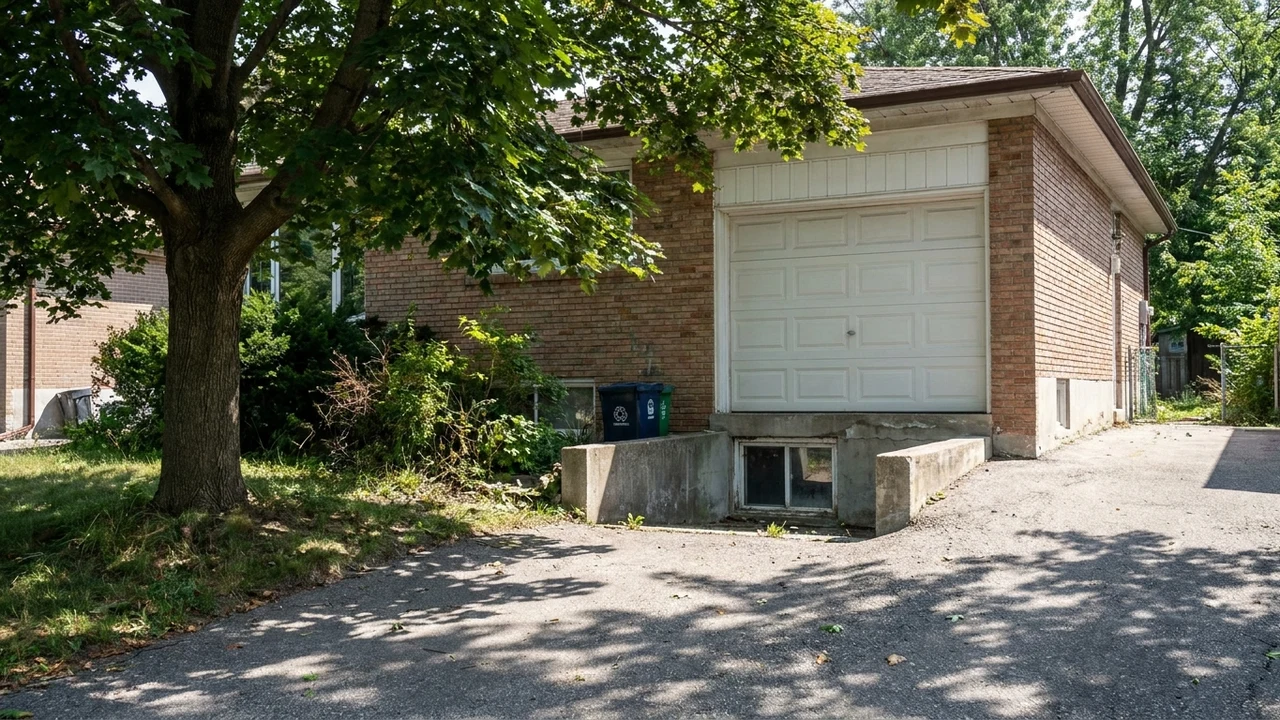
In a lot of GTA housing stock — side-splits and backsplits especially, common across Mississauga, Etobicoke, and Scarborough — the garage isn't off in its own corner of the house. Its slab sits partly over part of the basement, or its interior wall is the same wall that separates the garage from a below-grade bedroom or living room. That's the detail that matters more than square footage: if the garage and the basement apartment share a wall, a ceiling assembly, or a slab, whatever happens at the door and opener travels into that space as structure, not just as sound.
Before you assume a noise or access issue is "just how garages are," walk the shared boundary. Stand in the basement apartment — or where it will go — and have someone open and close the garage door a few times. If you can feel it, a thump through the wall or a hum through the floor, that's structure-borne transmission, and it needs a different fix than a rug or a curtain.
Why noise reads louder below grade than it does upstairs
A below-grade room built mostly of poured concrete and framed partition walls carries low-frequency vibration differently than a wood-framed upper floor does. The airborne sound of the door sliding on its track is rarely the actual complaint. It's the vibration from the spring cycling under tension and the opener's motor and drive mechanism running, both of which transfer through whatever they're bolted to — the ceiling joists above a basement suite, or the shared wall beside it.
This is why a basement apartment tenant will sometimes describe the garage as "loud" even when someone standing in the garage itself doesn't think it's particularly noisy. They're not wrong — they're experiencing a different kind of noise transfer than you are.
The three sources worth checking, in order
Before replacing anything, isolate where the vibration is actually coming from. Across our GTA service calls, it's almost always one of these three:
- The opener. A chain-drive opener runs a metal chain over a sprocket, and that mechanical action vibrates through the rail into whatever the rail is mounted to. It's the single biggest source of felt vibration in an adjoining room.
- The springs. Torsion springs mounted on a steel shaft above the door creak and pop as they wind and unwind under load, especially as they near the end of their cycle life. That sound carries through the header wall it's anchored to.
- Rollers and hinges. Worn or dry rollers rattle in the track on every open and close cycle. Smaller on its own, but it stacks on top of whatever the opener and springs are already transmitting.
The fastest fix if a tenant has already complained
Start with maintenance before spending on new equipment. A $120 tune-up covers lubrication, a balance check, and hardware tightening — a surprising share of "the garage is loud" complaints turn out to be dry rollers and loose hardware rattling on a door that's otherwise fine. If the rollers are actually worn rather than just dry, replacement runs $120-$220.
If the tune-up doesn't solve it, the opener is next. A chain-drive opener from $600 is the noisiest option by design. A belt-drive (DC) opener from $630 uses a rubber belt instead of a metal chain, cutting most of the mechanical vibration for a modest price difference — it's the single upgrade most likely to resolve a basement apartment noise complaint. Where the layout allows it, a side-mount opener from $900 goes a step further by moving the motor off the ceiling rail entirely, worth considering if the apartment's ceiling runs directly under the garage floor.
Springs are the other variable. If a torsion spring is aging and creaking through its cycle, address it on your own timeline rather than waiting for it to fail and turn the noise complaint into a door that won't open — a single spring runs $280, a double setup $320-$460.
Access and who actually controls the garage
When a basement apartment is a legal rental unit rather than space for family, garage access becomes a practical question, not just a noise one. Most GTA landlords keep the garage as owner-only storage and don't extend access to the tenant at all — in which case the remotes and any keypad access should be set up accordingly, and the safety sensors ($120-$180 to repair or realign) are worth checking if the tenant's vehicle regularly crosses the door's travel path in the driveway, even without garage access itself.
If the arrangement does give the basement tenant garage access — shared storage, a shared parking rotation — treat the door the way you'd treat a shared building entrance: sensors that actually work, a door that's balanced enough not to slam, and an opener that isn't going to wake someone up when a second household is coming and going on its own schedule.
What changes if part of the garage becomes part of the apartment
Some GTA homeowners go a step further and convert part of the garage itself into finished space adjoining the basement suite — a bedroom extension, a laundry room, a shared entry. Two things change here that are worth flagging before you start:
- Egress and fire separation. Most municipalities won't accept a basement apartment's required exit running through an attached garage, and an attached garage sharing a wall with living space typically needs its own fire-rated separation from that space. Confirm both with your local building department before finalizing the layout — it's a permit question, not a garage door one, but it decides what's structurally possible.
- The door's job doesn't go away. Whatever garage footprint remains still needs a properly sealed, balanced door. A worn perimeter seal on the remaining bay becomes the draft and noise path into the newly finished space next door, the same as in any garage conversion. We cover that side of the project — insulation, sealing, opener choice — in our guide on finishing part of a garage as living space.
Royal Garage Doors recommendation
If you're dealing with a noise complaint from an existing basement apartment, start with the $120 maintenance visit — it's the cheapest way to rule out dry rollers and loose hardware before spending on a new opener. If the opener itself turns out to be the source, a belt-drive (DC) unit from $630 is the upgrade we recommend most often for this exact situation. And if you're planning a new secondary suite next to or under the garage, get the door and opener sorted alongside the build, not after a tenant has already moved in and started noticing. See our full pricing page for current rates on openers, springs, and maintenance, or book a visit — the service call is free with any repair.
Related reading: Garage Door Considerations When Finishing Your Garage as Living Space.
Frequently Asked Questions
Will a garage door opener disturb someone living in the basement apartment below or beside it?
It can, especially with an older chain-drive opener — the rattling vibrates through the rail into the ceiling joists or shared wall and can be felt as much as heard in a below-grade room. Switching to a belt-drive (DC) opener from $630 removes most of that vibration; check the springs and rollers next if noise continues.
Can a basement apartment's required exit run through the attached garage?
Generally no — most Ontario municipalities require a secondary suite's exit to be independent of the garage, since an attached garage isn't treated as safe egress space. Confirm the exact requirement with your local building department before finalizing a basement apartment layout.
What's the most common noise complaint from basement apartment tenants about the garage?
The two most common are the opener's motor or chain vibration and the springs creaking as they cycle, both of which transmit through structure rather than air, so tenants often describe feeling a thump or hum rather than hearing a door open. A $120 maintenance visit that lubricates and rebalances the system resolves a lot of these cases.
Do I need a fire-rated door or wall between the garage and a basement apartment?
If the garage shares a wall with living space, most municipalities require fire separation between them, typically a self-closing, fire-rated door and a rated wall assembly. That's a construction and permit detail rather than something our overhead door service covers, but it's worth confirming before finishing any garage-adjacent space.
If part of my garage becomes living space next to the basement apartment, does the garage door still matter?
Yes — whatever garage footprint remains still needs a properly sealed, balanced door, and its condition affects the noise and drafts that reach the adjoining suite. See our guide on finishing part of a garage as living space for what changes when you convert.
Sources & standards: Garage door safety follows the UL 325 standard for automatic operators. For safe manual operation, see Chamberlain's emergency-release guidance. Pricing reflects current Royal Garage Doors rates for the GTA.
The bottom line: done right, the result is a garage door that opens quietly, balances correctly and is safe to use every day — backed by Royal's 1-year labour warranty so the outcome lasts.