Garage Doors for Rural and Semi-Rural GTA Properties

Royal Garage Doors has customer feedback on its Etobicoke Google profile and technicians with hands-on experience installing and repairing doors across Toronto and the wider GTA.
What should you consider when buying a garage door for a rural or semi-rural GTA property?
For rural and semi-rural GTA properties in Caledon, King Township, and Georgetown, the right garage door setup accounts for open-field wind exposure, gravel-road dust, and equipment sized well past a standard sedan.
Do rural garage doors need to be wind-rated differently than city doors?
There's no separate 'rural' door product, but wider doors on open, unshielded acreage need adequate horizontal reinforcement struts and a track properly fastened into solid framing. A door that bows
- Customer feedback
- Read our Google reviews (Etobicoke profile)
- Experience
- Garage door service across the GTA
- Repair warranty
- 1-year parts and labour unless a specific written warranty overrides it
- Author
- Royal Garage Doors, Garage door repair and installation
Why a rural garage door job isn't the same as a subdivision one
Most of our installs are a single 8×7 or a double 16×7 on an attached garage in a production-built subdivision — Brampton, Vaughan, Mississauga. The door, the opener, and the opening were all sized by a builder for one or two sedans, and the house itself blocks a lot of wind and weather before it ever reaches the door.
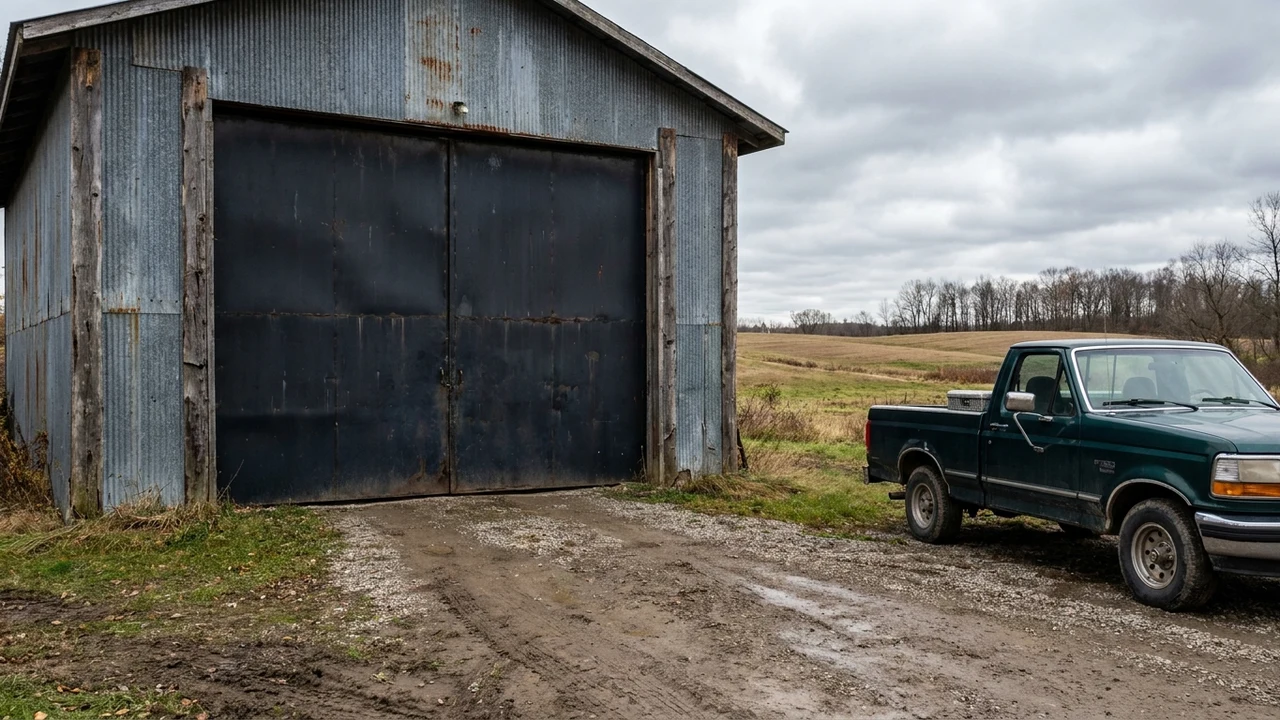
Properties on the fringe of Caledon, King Township, and the rural edges of Georgetown are a different job. The garage is often detached — a pole barn, a machine shed, a standalone shop building sitting well away from the house on open acreage. It's exposed on all sides, it's built around equipment rather than a commuter car, and it usually goes weeks between uses instead of twice a day. All three of those differences change what door, opener, and maintenance plan actually make sense.
Start with what you're actually parking, not what came with the building
On an acreage property the door opening should match the equipment, not a standard car stall. Before you settle on a size, measure the widest and tallest thing that has to fit through — with the mirrors folded in on a truck, and with any loader arms or attachments at their travel height on a tractor, not resting on the ground.
- Pickup with a tool box or ladder rack: check the rack height, not just the cab — it's usually the tallest point.
- Compact or utility tractor: measure with the loader bucket at carry height, and add clearance for the ROPS bar if it doesn't fold.
- Trailer or RV storage: width at the widest fender or slide-out, not the hitch.
Our standard range covers a single 8×7 ($1,350), 9×7 ($1,500), and 10×7 ($1,650), up to a 15×7 or 16×7 double at $2,300. If what you're storing needs more height or width than a standard 7-foot-tall opening allows, that's exactly the kind of thing to flag during the on-site assessment rather than guess at — our price calculator is a good starting point, but a taller or wider-than-standard opening gets confirmed in person.
Open exposure means more wind load on the door itself
A door on a Brampton cul-de-sac is shielded by neighbouring houses, fences, and mature trees. A door on an open concession road in King Township or up on the Caledon escarpment gets full, unbroken wind — and a garage door is one of the largest single surfaces on most rural buildings, which makes it the thing that takes the load.
The practical fix isn't a special "rural" door — it's making sure the door has adequate horizontal reinforcement struts for its width, and that the track and header are properly fastened into solid framing, not just the sheeting. This matters most on wider doors (15×7 and up) and on buildings without a windbreak of trees or outbuildings nearby. If your existing door rattles, bows visibly in a strong gust, or has come off-track after wind, that's a sign the reinforcement wasn't matched to the exposure in the first place — off-track repair runs $180–$450 depending on what's bent or displaced.
Gravel roads and dust wear out tracks and rollers faster
Dust from a gravel driveway or a dirt access road works its way into the tracks and roller bearings every time the door cycles. In a paved subdivision that grit mostly stays out. On a gravel-road property it builds up steadily, and it's the single biggest reason rural doors start binding, grinding, or running rough years before an equivalent city door would.
Two things help. First, rollers built for higher-cycle, dustier use hold up better than the lightest stock ones — roller replacement runs $120–$220. Second, cut the interval between tune-ups roughly in half compared to a typical subdivision home. A $120 maintenance visit — lubrication, balance check, hardware tightening, track inspection — twice a year instead of once catches grit-related wear before it turns into a $180–$350 track repair.
Detached garages and barns change the opener decision
Two things are different about opener installs on a detached rural building: the power run, and the ceiling.
A long underground or overhead power run to a detached garage or barn can mean more voltage drop than the same opener would see on a house circuit — worth a quick check before assuming any opener will run the same as it would in an attached garage. And a lot of barns and machine sheds have exposed roof trusses, hay lofts, or ceiling-mounted storage racks with no clear space for a standard trolley opener running along the ceiling.
That's where a side-mount opener earns its keep — it drives the door from a unit mounted beside the track rather than overhead, so it doesn't need ceiling clearance at all. We install those from $900, with Wi-Fi included. For a straightforward detached garage with normal headroom, a chain-drive opener from $600 or a belt-drive DC unit from $630 is more than enough, and a smart/myQ opener ($760–$1,200) is worth it if you want to check the barn door from your phone when you're out in the field.
Material and insulation for a space you don't heat
Not every rural building needs an insulated door. A machine shed or hay storage barn that's never heated gets no real benefit from paying for insulation — a standard steel door in any of our no-upcharge colours (White, Almond, Sandstone, Charcoal, Dark Gray, Brown, Dark Brown, Black) does the job. If the building is a heated workshop, a garage you actually work in through the winter, insulation is worth the conversation the same way it would be on a house.
On the appearance side, a lot of rural and hobby-farm properties lean into a farmhouse look — a woodgrain finish (+$300) on a barn-style door reads a lot closer to that than a flat steel colour, without the upkeep of an actual wood door.
What to expect from an on-site assessment
Rural addresses take a bit more setup than a subdivision call — longer driveways, sometimes a building set well back from the road, and equipment that needs to be measured rather than assumed. The service call itself is free with any repair or installation, and it's where wind exposure, power access, and actual equipment dimensions get confirmed before anything's quoted. If you're only trying to figure out whether the door should stay a straight repair — say a spring, an off-track panel, or worn rollers — versus a full replacement, that's also a call worth making before buying anything.
Royal Garage Doors recommendation
If you're on acreage in Caledon, King Township, Georgetown, or anywhere else on the rural fringe of the GTA, don't default to a standard subdivision door size and hope your equipment fits — measure what you're actually parking first, and flag the exposure and power situation when you book. Royal Garage Doors has handled both ends of this: production doors on city lots and detached-garage and barn installs on open acreage, backed by 1-year labour, 5-year hardware, and lifetime panel warranties on every installed door. See current sizes and options on our pricing page, or book a free on-site assessment to get your actual opening and equipment measured.
Related reading: Garage Door Buying Guide for GTA Farmhouses and Estate Homes.
Frequently Asked Questions
Do rural garage doors need to be wind-rated differently than city doors?
There's no separate 'rural' door product, but wider doors on open, unshielded acreage need adequate horizontal reinforcement struts and a track properly fastened into solid framing. A door that bows or rattles in strong wind usually wasn't reinforced for its exposure in the first place.
Can you install an opener in a barn or detached garage with low headroom?
Yes — a side-mount (jackshaft-style) opener mounts beside the track instead of running along the ceiling, so it works in barns with exposed trusses, hay lofts, or ceiling storage. We install those from $900 with Wi-Fi included.
What size garage door do I need for a tractor or larger farm equipment?
Measure the tallest and widest point of what you're storing at its actual travel position — loader bucket at carry height, mirrors folded on a truck. Our standard sizing runs from an 8×7 single up to a 16×7 double at $2,300; anything larger gets confirmed on-site.
How often should a garage door be serviced on a gravel driveway property?
Roughly twice a year instead of the usual once, since gravel dust works into tracks and roller bearings faster than it would on a paved driveway. A $120 maintenance visit catches grit-related wear before it turns into a track repair.
Does Royal Garage Doors service rural addresses like Caledon, King Township, and Georgetown?
Yes. The service call is free with any repair or installation, and for rural properties it's also where we confirm wind exposure, power access to detached buildings, and actual equipment dimensions before quoting anything.
Sources & standards: Garage door safety follows the UL 325 standard for automatic operators. For safe manual operation, see Chamberlain's emergency-release guidance. Pricing reflects current Royal Garage Doors rates for the GTA.
The bottom line: done right, the result is a garage door that opens quietly, balances correctly and is safe to use every day — backed by Royal's 1-year labour warranty so the outcome lasts.