What GTA Renters Should Know About Garage Door Responsibility

Royal Garage Doors has customer feedback on its Etobicoke Google profile and technicians with hands-on experience installing and repairing doors across Toronto and the wider GTA.
Who is responsible for garage door repairs in a rental property?
In Ontario, garage door repairs on a rental property are the landlord's responsibility — the Residential Tenancies Act requires landlords to keep the rental unit, including an attached garage, in good repair. Tenants only handle basic upkeep like remote batteries and sensor lens cleaning.
Does a landlord have to fix a broken garage door spring in a rental?
Yes. Under Ontario's Residential Tenancies Act, landlords must maintain the rental unit, including an attached garage door system, in a good state of repair. A broken torsion spring is a
- Customer feedback
- Read our Google reviews (Etobicoke profile)
- Experience
- Garage door service across the GTA
- Repair warranty
- 1-year parts and labour unless a specific written warranty overrides it
- Author
- Royal Garage Doors, Garage door repair and installation
Who's on the hook: the landlord/tenant split in Ontario
Ontario's Residential Tenancies Act puts a general maintenance duty on landlords: keep the rental property in a good state of repair and fit for habitation, and that duty doesn't stop at the interior walls. A garage that's part of the house — or a dedicated attached garage on a townhome — falls under the same obligation as the furnace or the roof. If it's original equipment on the property, maintaining it is the landlord's job.
Tenants have a narrower duty: keep the unit reasonably clean, and don't cause or allow damage beyond ordinary wear and tear. That's the line that decides who pays. A part failing because it's old is the landlord's problem. A part breaking because of something you or a guest did is yours.
What counts as normal wear and tear
Garage door systems are built with components that are designed to wear out over years of daily cycling, not because anyone did anything wrong. If you're renting a house in Mississauga, Brampton, or Vaughan with an attached garage, these are the failures that show up on their own with age and use — and they're squarely the landlord's to fix:
- Torsion springs losing tension after tens of thousands of open/close cycles
- Cables fraying where they wrap the drum
- Rollers cracking or wearing down, especially the original plastic ones
- Opener components — a capacitor or logic board failing after years of use
- Weatherstripping drying out, cracking, and letting in drafts
- Sensor LEDs dimming or lenses fogging from age, not dirt
None of this is something a tenant caused, and none of it is something a tenant should be paying to fix out of pocket.
What's tenant-caused damage, not wear and tear
The other side of that line is damage from something that happened, not something that simply aged out. A few examples that come up often in rental properties:
- Backing a car or trailer into a closed door — bent panels, a knocked-off track, or a snapped cable
- Forcing a door that's stuck or jammed instead of stopping and reporting it — this is how a track gets bent or a cable jumps the drum
- Kids or guests treating the wall button or remote roughly, or defeating the safety sensors to "make it work"
- Storing bikes, bins, or furniture where they block the sensor beam and then yanking the door manually to get around it
If a technician can point to an event — an impact, forced movement, tampering — that cost typically lands on the tenant, separate from the landlord's maintenance obligation for ordinary failure.
What you should just handle yourself
Not everything needs a landlord phone call. A handful of things are genuinely low-effort, low-risk, and reasonable for a tenant to take care of the same way you'd swap a smoke detector battery:
- A dead remote or keypad battery. If the remote stopped working but the wall button still opens the door, it's almost always the battery — a $2-3 fix, not a repair.
- Dirty sensor lenses. The two small units near the floor on each side of the track can get dusty or cobwebbed. Wipe both with a soft cloth.
- Debris in the track. Leaves, dirt, or a stray toy sitting in the track can make the door bind. Clear it and see if the problem goes away.
- A loose wall button cover. If it's rattling but still functions, a quarter-turn of a screwdriver on visible screws is fine.
These take five minutes and solve a real share of "the garage door isn't working" calls before they ever need to become a maintenance request.
When it's time to call the landlord, not a wrench
Anything involving spring tension, the opener's internal wiring, or the door coming off its track is not a DIY fix — for a homeowner or a tenant. Report these right away rather than working around them:
- A door that won't stay up, drops suddenly, or one side hangs lower than the other — usually a broken spring, and a door under uneven spring tension can fall
- The door has come off the track, or you can see the roller sitting outside the rail
- The opener runs (you hear the motor) but the door doesn't move, or it reverses on its own partway through closing
- Grinding, popping, or a loud snap followed by the door not moving at all
- Sensors that stay misaligned no matter how many times you clean and re-aim them — that usually means a bent bracket, not dirt
Never disable or unplug a safety sensor to force a stubborn door closed. That sensor is there to stop the door from closing on a car, a pet, or a person, and bypassing it turns a maintenance issue into a genuine safety hazard.
How to report it so it actually gets fixed
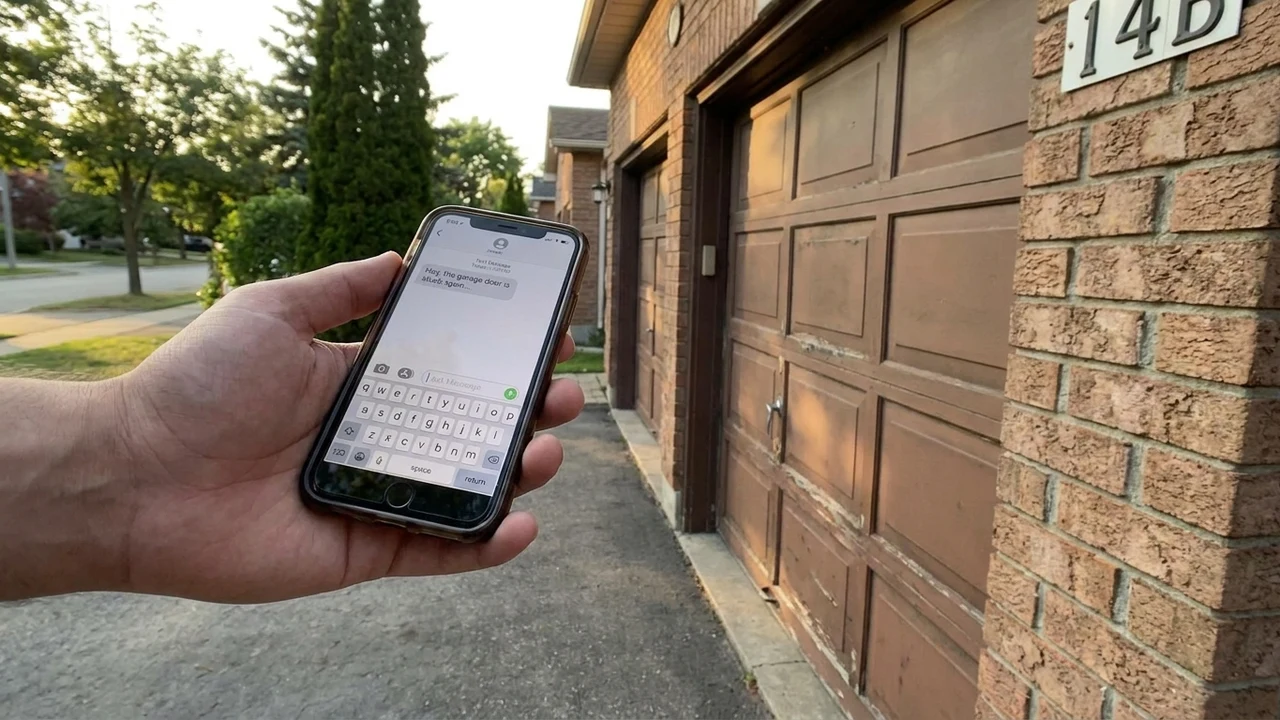
Put the request in writing — a text or email works, and it creates a timestamp. Include what's happening (won't close, reverses, grinding noise), when it started, and whether it affects your ability to secure the garage. A door that won't close all the way is a security issue, not just an inconvenience, and it's worth saying so plainly. A short video of the door misbehaving is often more useful than a paragraph of description.
Keep a copy of what you sent. Most GTA landlords and property managers act on a clear, specific report quickly — many already have a repair company they call directly rather than handling it themselves, which is often the fastest path since it skips a back-and-forth about what's actually wrong.
If the landlord doesn't respond
Follow up once in writing and give a reasonable window — a broken spring or a door that won't secure isn't something that should sit for weeks. If a landlord continues to ignore a legitimate repair, Ontario tenants can file a maintenance complaint with the Landlord and Tenant Board. Withholding rent on your own as a workaround isn't the safe move here; it creates its own legal exposure. Document, follow up, and escalate through the LTB if it comes to that.
Royal Garage Doors recommendation
Whether you're a tenant flagging an issue or a landlord who needs it handled without a site visit turning into a hassle, Royal Garage Doors works directly with GTA property owners and managers on rental repairs — springs, openers, cables, tracks, and sensors. The service call is free with any repair, and a single torsion spring replacement starts at $280 plus tax. See current rates on our pricing page, or book a repair visit and we'll coordinate access and timing directly with whoever's paying the bill.
Related reading: Garage Door Maintenance for Landlords and Rental Properties.
Frequently Asked Questions
Does a landlord have to fix a broken garage door spring in a rental?
Yes. Under Ontario's Residential Tenancies Act, landlords must maintain the rental unit, including an attached garage door system, in a good state of repair. A broken torsion spring is a normal wear-and-tear failure, not tenant negligence, so arranging and paying for the repair falls on the landlord.
What if I damaged the garage door myself, like backing my car into it?
Damage you or a guest caused isn't covered by the landlord's maintenance duty. You're generally responsible for the cost of repairing damage from an event like an impact or forcing a stuck door, separate from normal wear and tear like a spring wearing out or a roller going bad.
Can I fix a garage door problem myself to save time?
Stick to genuinely low-risk tasks — replacing a remote's battery, wiping the sensor lenses, clearing debris from the track. Never touch the torsion spring yourself; it's under enough tension to cause serious injury, and in a rental it isn't your repair to make anyway.
How should I report a garage door problem to my landlord?
Put it in writing — a text or email works. Include the date, a description of what's happening (won't close, reverses, grinding noise), and note if it's a security issue, like the door not being able to close and lock the garage. A short video helps and keep a copy for your records.
What if my landlord ignores a garage door repair request?
Follow up once in writing and give a reasonable window to respond. If a landlord in Ontario continues to ignore a legitimate maintenance issue, tenants can file a maintenance complaint with the Landlord and Tenant Board rather than withholding rent, which carries its own risk.
Sources & standards: Garage door safety follows the UL 325 standard for automatic operators. For safe manual operation, see Chamberlain's emergency-release guidance. Pricing reflects current Royal Garage Doors rates for the GTA.
The bottom line: done right, the result is a garage door that opens quietly, balances correctly and is safe to use every day — backed by Royal's 1-year labour warranty so the outcome lasts.