Why Two Garage Doors on the Same House Behave Differently

Royal Garage Doors has customer feedback on its Etobicoke Google profile and technicians with hands-on experience installing and repairing doors across Toronto and the wider GTA.
Why does one garage door wear out before the other?
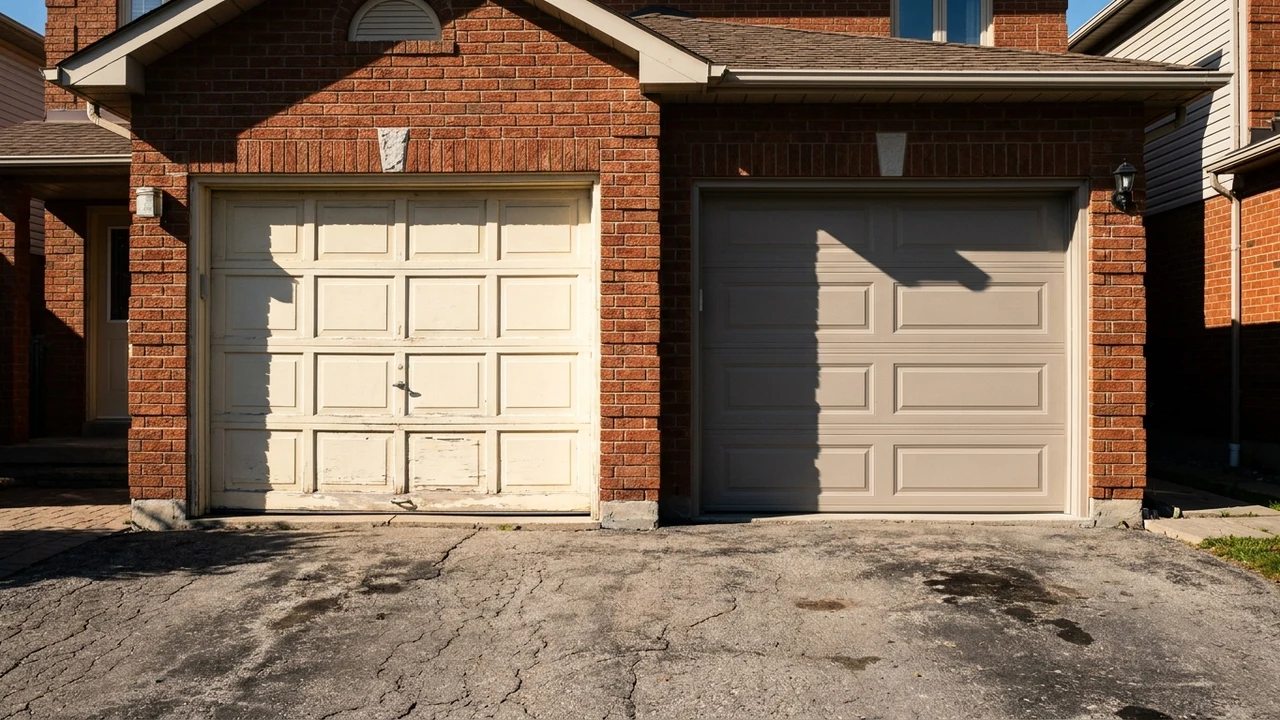
Two garage doors on the same house wear unevenly because they rarely carry the same workload — one side handles the daily-driver cars while the other sits mostly idle, or one door bakes in afternoon sun while the other stays shaded.
Should I service both garage doors at the same time even if only one is acting up?
Not necessarily. Service the door that's showing symptoms — noise, slow closing, an uneven gap when open — and let the technician check the quiet door while they're there. If
- Customer feedback
- Read our Google reviews (Etobicoke profile)
- Experience
- Garage door service across the GTA
- Repair warranty
- 1-year parts and labour unless a specific written warranty overrides it
- Author
- Royal Garage Doors, Garage door repair and installation
It isn't a manufacturing defect — it's two different jobs
We get some version of this call every month, usually from a homeowner in a Vaughan or Oakville two-car-garage subdivision: "Both doors are the same age, same brand, installed the same week — why is only one of them making noise?" The short answer is that "installed the same week" is the only thing that's actually identical. From the day the installer leaves, the two doors start living different lives, and by year five or six that difference shows up as one door needing a repair the other doesn't.
None of the reasons below point to a bad door or a bad install. They're mechanical and environmental, and once you know what to look for, the uneven wear on your own garage usually explains itself in about thirty seconds.
Cycle count matters more than calendar age
A torsion spring, an opener's drive gear, and the rollers riding in the track are all wear items that respond to how many times the door opens and closes — not to how many years have passed. On most two-car layouts, one bay is the daily-driver door: it opens for the morning commute, again at lunch if someone works from home, again when the kids get dropped off, again in the evening. The second bay holds a second vehicle, a workshop, or storage, and might open three or four times a week.
Run that gap for five or six years and the daily-use door has gone through several times the open-close cycles of its twin, even though a calendar would say they're the same age. Springs, cables, and rollers all have a working life measured in cycles, so the door doing the real work is always going to be the first one to ask for a repair — typically a $280 single-torsion-spring replacement, or $320–$460 if both springs on that side need to go at once.
Sun exposure changes how hardware ages
Garage orientation matters more than most homeowners expect. On a lot where one bay faces west or south and gets direct afternoon sun through a Toronto or Mississauga summer, the steel door skin and the track hardware run noticeably hotter than a shaded, north-facing bay on the same house. Heat cycling dries out lubricant faster, makes rubber weatherstripping crack and shrink sooner, and puts additional stress on a spring that's already near the end of its working life from cycle count alone.
If you've ever noticed that the sun-facing door on a corner lot needs its weather stripping replaced (typically $120–$260) years before the shaded door does, that's why. Same house, same install date, different amount of daily heat load.
Mismatched opener ages tell their own story
A lot of two-door garages don't actually have same-age openers, even if the doors themselves went in together. It's common for one opener to get replaced early — after a remote stopped working, after a board failure, or during a renovation — while the original unit keeps running on the other side. A few years later, one door has a quieter belt-drive opener from $630 and the other is still running the original chain-drive unit, now grinding and due for a gear kit or logic board repair (opener repair generally runs $120–$550 depending on what's failed).
If your two openers sound different, run at different speeds, or one has Wi-Fi/smart-app control and the other doesn't, that's not a mismatch to worry about — it's just a record of when each one was last touched.
A double door and a single door were never working equally hard
Plenty of GTA homes don't have two identical single doors — they have one double (15×7 or 16×7) and one single (8×7, 9×7, or 10×7) sharing the same garage. A double door is significantly heavier than a single, which means its torsion spring, its cables, and its opener are all working harder on every cycle just to lift the panel. Even with identical usage patterns, the double-door side tends to need spring and cable attention (cables & brackets typically run $180–$260) sooner than the single simply because it's moving more weight every time.
This is also why we don't recommend swapping parts between the two sides "to save a trip" — a spring sized for a single door won't balance a double door correctly, and an undersized spring is one of the fastest ways to burn out an opener's drive gear.
What uneven wear typically looks like
Here's the pattern we see most often when a two-door garage gets a full inspection:
| Symptom | Daily-use / sun-facing door | Low-use / shaded door |
|---|---|---|
| Spring condition | Sagging coils, visible gap when open, closer to end of cycle life | Still tight, minimal gap |
| Opener noise | Grinding, straining on lift, slower travel | Smooth, consistent speed |
| Weatherstripping | Cracked, shrunk, gaps at the bottom seal | Pliable, sealing evenly |
| Rollers/track | Squeaking, visible wear marks, occasional off-track | Quiet, tracking straight |
If that table describes your garage — one door doing all the talking while the other stays silent — you're not dealing with a defect. You're looking at the normal result of unequal cycles and unequal sun.
Don't let the healthy door talk you out of servicing the tired one
The most common mistake we see is a homeowner assuming that because one door is fine, the whole system must be fine — so a squeak or a slow close on the other door gets ignored until it fails at the worst possible moment, usually a spring letting go with the car halfway in or out. The two doors should be on their own maintenance clocks, not a shared one.
A $120 maintenance and tune-up on the harder-working door — lubrication, balance check, sensor alignment, hardware tightening — catches the early warning signs (a slightly uneven close, a new squeak, a spring coil that's started to gap) before they turn into an off-track repair ($180–$450) or a full panel replacement ($500–$1,000). The quiet door on the other side might not need that service for another year or two, and that's fine — it's not a sign you're overdue on both.
Royal Garage Doors recommendation
If one door on your two-car garage is louder, slower, or squeakier than the other, that's normal wear telling you exactly where to look first — not a reason to worry about the whole system. Book a service call for the door that's actually complaining; it's free with any repair, and a technician can check the spring, cables, rollers, and opener on that side in one visit. If it turns out the quiet door is closer to needing attention than it looks, we'll tell you honestly rather than sell you a matching repair it doesn't need.
See current rates on our pricing page, or book your visit directly — Royal Garage Doors has serviced two-door GTA garages and has customer feedback on our Etobicoke Google profile.
Related reading: How Often Does a Busy GTA Family's Garage Door Need Servicing.
Frequently Asked Questions
Should I service both garage doors at the same time even if only one is acting up?
Not necessarily. Service the door that's showing symptoms — noise, slow closing, an uneven gap when open — and let the technician check the quiet door while they're there. If it's not close to needing attention, there's no benefit to repairing it early just to match the other side.
Is it normal for one garage door opener to be louder than the other?
Yes, especially if the two openers were installed at different times or one is an older chain-drive unit while the other is a newer belt-drive. Gear wear and drive type both affect noise level independently of the door's age.
Does sun exposure really shorten a garage door's lifespan that much?
It's meaningful. A west- or south-facing door on a Toronto-area summer afternoon runs hotter than a shaded one, which dries out lubricant faster and shrinks weatherstripping sooner. It's usually a difference of a few years, not a dramatic one, but it's real.
If one spring breaks, should I replace the spring on the other door too as a precaution?
Only if it's genuinely close to the same cycle count and condition — for example, two identical single doors used roughly equally. If one door is a rarely-used single and the other a daily-use double, they were never going to wear at the same rate, so a working spring on the low-use side usually doesn't need preventive replacement.
Can a double door and a single door on the same house share the same opener specs?
They can both run reliable openers, but the double door's heavier panel puts more strain on its spring, cables, and drive gear per cycle. Don't swap springs or hardware between a single and a double door — they're sized differently for a reason.
Sources & standards: Garage door safety follows the UL 325 standard for automatic operators. For safe manual operation, see Chamberlain's emergency-release guidance. Pricing reflects current Royal Garage Doors rates for the GTA.
The bottom line: done right, the result is a garage door that opens quietly, balances correctly and is safe to use every day — backed by Royal's 1-year labour warranty so the outcome lasts.