Garage Door Track Lubrication: What to Use and What to Avoid

Royal Garage Doors has customer feedback on its Etobicoke Google profile and technicians with hands-on experience installing and repairing doors across Toronto and the wider GTA.
What Should You Use to Lubricate a Garage Door Track?
Garage door track lubrication doesn't mean oiling the track itself — the track should stay dry, while rollers, hinges, springs, and the opener rail need a light coat of lithium-based garage door lubricant twice a year.
Should you lubricate the garage door track itself?
No. The track should stay dry and clean. Spraying lubricant into the track channel just collects dust, grit, and winter road salt residue, turning it into an abrasive paste that
- Customer feedback
- Read our Google reviews (Etobicoke profile)
- Experience
- Garage door service across the GTA
- Repair warranty
- 1-year parts and labour unless a specific written warranty overrides it
- Author
- Royal Garage Doors, Garage door repair and installation
The track itself should stay dry
This is the single most common mistake we see when we pull a service ladder up to a "squeaky door" call: someone sprayed lubricant straight into the metal track channel, thinking that's what makes the door glide. It's the opposite. The track is a guide rail — the roller wheel is what's supposed to move smoothly, and it does that by rolling, not by sliding through oil.
Spray anything into the track itself and you've built a dust trap. In an attached GTA garage, that channel is already collecting driveway grit, blown-in leaves, winter sand, and road salt residue tracked in on tires. Add oil or grease to that mix and it turns into a gray paste sitting exactly where the roller needs to run clean. Within a season, the door starts binding intermittently, the opener has to work harder to pull it through the rough spots, and the roller wheel wears against that grit like sandpaper instead of gliding past it.
If your track has visible grime on it right now, the fix isn't more lubricant — it's a wipe-down with a dry or slightly damp rag first, then leaving it bare.
What actually needs lubrication
Every moving metal-on-metal contact point on the door gets a light coat — the track itself is the one part on this list that doesn't:
- Roller stems and bearings — where the wheel spins on its shaft, not the wheel-to-track contact
- Hinges between each panel section, at the pivot pin
- Torsion spring coils — the full length of the spring above the header
- The opener's drive rail — chain or screw-drive systems specifically; belt drives don't need it
- The lock bar and latch mechanism, if your door has one
Nylon rollers with sealed bearings need the least attention — the bearing is pre-lubricated and sealed, so you're really just checking it still spins freely. Steel rollers, older torsion springs, and opener rails are where seasonal lubrication actually earns its keep.
Use a lithium-based garage door lubricant, not whatever's on the shelf
Buy a product actually labeled "garage door lubricant." Most are a lithium-based aerosol formulated to do two things at once: penetrate into the tight metal-on-metal contact points, then set up as a thin, dry-to-touch film rather than staying wet and tacky. That dry-film behaviour is the whole point — it lubricates without staying open to airborne dust the way a wet oil or grease film does.
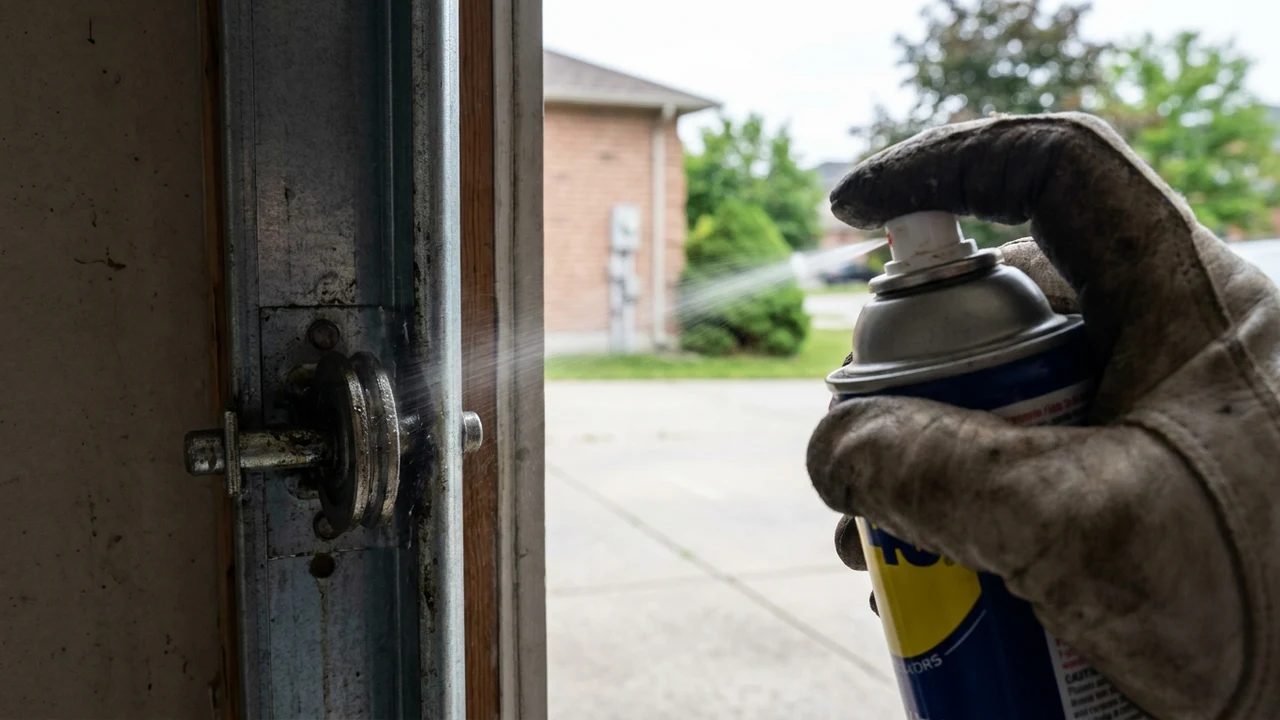
Apply it with the straw nozzle directly at each hinge pin and roller stem, a short one-to-two-second burst per point. Then run the door up and down two or three times by hand or with the opener so the lubricant works itself into the joint. Wipe off anything that drips or pools — excess lubricant sitting on the surface just collects the same dust it's supposed to keep out.
Why WD-40 falls short here
WD-40 is a water-displacer and penetrating solvent first, a lubricant a distant second. It's genuinely useful for breaking a rusted, seized bolt loose. But its light carrier oil evaporates within days, and as it evaporates it can actually strip away whatever lubricant was already on the part. That's why a door sprayed with WD-40 sometimes squeaks louder a week later than it did before — you didn't lubricate the hinge, you temporarily masked the noise and then washed the joint drier than it started.
Why motor oil and household 3-in-1 oil cause more wear, not less
Straight motor oil, cooking oil, or a generic household oil can lubricate briefly, but they're too thin for the load a spring coil or roller bearing carries. Thin oil runs off the part within a day or two — often straight down onto the driveway or garage floor, where it stains concrete — leaving the contact point dry again almost immediately. And on the way down, that runny oil picks up the same dust and grit floating around the garage, so what's left behind on the part isn't lubricant, it's an abrasive film.
Why thick grease is the wrong call, especially on springs
Chassis grease, wheel-bearing grease, or a generic tub of grease from the hardware store is tacky by design — that's what makes it stay put on a trailer hitch. On a garage door, that same tackiness is the problem. It grabs airborne dust, garage insulation fibers, and through a GTA winter, the fine sand and salt residue that gets tracked in and circulated by the furnace fan. Over a few months, that grit-loaded grease becomes a grinding compound sitting exactly on the parts that are supposed to move freely, wearing spring coils and bearings down faster than if you'd used nothing at all.
It also visually hides the spring itself. A torsion spring that's developing a hairline stress crack needs to be seen during a seasonal check, not caked under a layer of dark grease. If a spring does fail from the added wear, a single torsion spring replacement runs $280 plus tax; a double setup runs $320–$460.
How often and how much — the GTA seasonal angle
Twice a year is the right cadence, and it lines up with the two points GTA weather stresses hardware the most: going into winter and coming out of it. A -20°C to +30°C swing changes how metal contracts and how any residual lubricant behaves, so re-doing it each spring and fall keeps every joint moving through both extremes instead of just one.
Amount matters more than people expect. A short burst per point is enough — hinges, roller stems, the full spring, and the opener rail. Over-applying doesn't add protection, it just adds more surface area for dust to stick to.
| Part | Lubricate? | What to use |
|---|---|---|
| Track channel | No | Wipe clean, leave dry |
| Roller stems/bearings | Yes | Lithium-based garage door lubricant spray |
| Hinges | Yes | Lithium-based garage door lubricant spray |
| Torsion spring coils | Yes | Lithium-based garage door lubricant spray |
| Opener chain/screw rail | Yes | Lithium-based garage door lubricant spray |
| Opener belt rail | No | Not required |
Royal Garage Doors recommendation
Lubrication is cheap insurance and one of the few things a homeowner can genuinely do right without a technician — as long as you're using the right product on the right parts and leaving the track alone. If it's been more than six months, or you're not sure what's already been sprayed on there, our $120 maintenance package covers proper lubrication along with a balance check, safety sensor alignment, and a hardware tightening pass, so nothing gets missed. And if a spring, roller, or opener component has already worn out from the wrong lubricant, see our full pricing page for current rates before you book a repair or maintenance visit — the service call itself is free with any repair.
Related reading: How Often Should You Replace Garage Door Rollers?.
Frequently Asked Questions
Should you lubricate the garage door track itself?
No. The track should stay dry and clean. Spraying lubricant into the track channel just collects dust, grit, and winter road salt residue, turning it into an abrasive paste that wears down the roller wheel faster instead of helping it glide.
Can you use WD-40 on a garage door?
WD-40 is a penetrating solvent, not a long-term lubricant. Its light carrier oil evaporates within days and can strip away existing lubrication, which is why doors sometimes squeak louder a week after being sprayed with it. Use a lithium-based garage door lubricant instead.
How often should you lubricate a garage door in the GTA?
Twice a year — spring and fall — lines up well with the temperature swings GTA weather puts hardware through, from winter cold down to -20°C up to summer heat near 30°C.
What's the best lubricant for garage door springs?
A lithium-based aerosol garage door lubricant applied along the full length of the spring coils. Avoid thick chassis or bearing grease, which is tacky enough to trap dust and grit and can hide early spring cracks.
What happens if you use too much grease on garage door rollers?
Excess grease attracts airborne dust and driveway grit, which packs into the bearing and wears it down faster than no lubrication at all. If a roller fails from that buildup, replacement runs $120-$220.
Sources & standards: Garage door safety follows the UL 325 standard for automatic operators. For safe manual operation, see Chamberlain's emergency-release guidance. Pricing reflects current Royal Garage Doors rates for the GTA.
The bottom line: done right, the result is a garage door that opens quietly, balances correctly and is safe to use every day — backed by Royal's 1-year labour warranty so the outcome lasts.