How Often Should You Replace Garage Door Rollers?

Royal Garage Doors has customer feedback on its Etobicoke Google profile and technicians with hands-on experience installing and repairing doors across Toronto and the wider GTA.
How often do garage door rollers need to be replaced?
Garage door rollers should be replaced based on use, not age — most residential nylon rollers last roughly 7 to 10 years of typical daily cycling, while cheaper steel rollers often wear out in 3 to 5. Catching worn rollers early avoids costlier track damage, and Royal Garage Doors replaces them for $120 to $220.
How do I know if my garage door rollers need replacing?
Listen and watch. Grinding or squealing that lubrication doesn't fix, a door that shudders or hesitates at the same point every cycle, or rollers you can see are cracked, flat-sided,
- Customer feedback
- Read our Google reviews (Etobicoke profile)
- Experience
- Garage door service across the GTA
- Repair warranty
- 1-year parts and labour unless a specific written warranty overrides it
- Author
- Royal Garage Doors, Garage door repair and installation
Rollers wear out on cycles, not years on the wall
A "cycle" is one full open-and-close of the door. A single-car garage used mainly for the car — door up in the morning, down at night — might run 700 to 900 cycles a year. A busy household with two drivers, a home gym in the garage, or kids in and out all day can push past 1,500 to 2,000 cycles in the same twelve months. Two doors installed the same week can be years apart in real wear, even though the calendar says they're the same age.
That's why "how old is the door" is the wrong question. The right one is closer to "how many times has it run." If you can't count cycles, use of the garage is a decent proxy: a door that opens four to six times a day is going to need new rollers well before one that opens twice.
Nylon vs. steel rollers — what actually wears faster
Most doors installed in the GTA over the last 10-15 years use one of two roller types, and they don't wear at the same rate.
| Roller type | Typical residential lifespan | Noise | Notes |
|---|---|---|---|
| Nylon, sealed ball bearing | Roughly 7-10 years of normal daily use | Quiet — the standard upgrade when replacing steel | Bearing is sealed and pre-lubricated; the wheel itself is usually what eventually cracks or wears |
| Steel, ball bearing | Similar to nylon, sometimes longer under heavy or frequent-use doors | Noticeably louder, especially as bearings dry out | Holds up well to heavy doors and frequent cycling but transmits more vibration into the house |
| Steel, no ball bearing (builder-grade) | Often 3-5 years before they're audibly rough | Loudest option, gets louder with wear | Common on builder-grade doors installed to a budget; usually the first thing worth upgrading |
If your door has always been a little loud, or you're replacing rollers for the second time in under ten years, there's a decent chance you've got the economy steel rollers rather than sealed nylon. Swapping to nylon at that point is worth asking about — it's the same labour to install, and you get a quieter door out of the same repair.
The signs show up before a roller actually fails
Rollers rarely fail without warning. Watch and listen for:
- New grinding or squealing that a shot of lubricant on the track doesn't fix after a day or two.
- A shudder or hesitation at the same point in the door's travel every time — usually where a specific bad roller crosses the curved section of track.
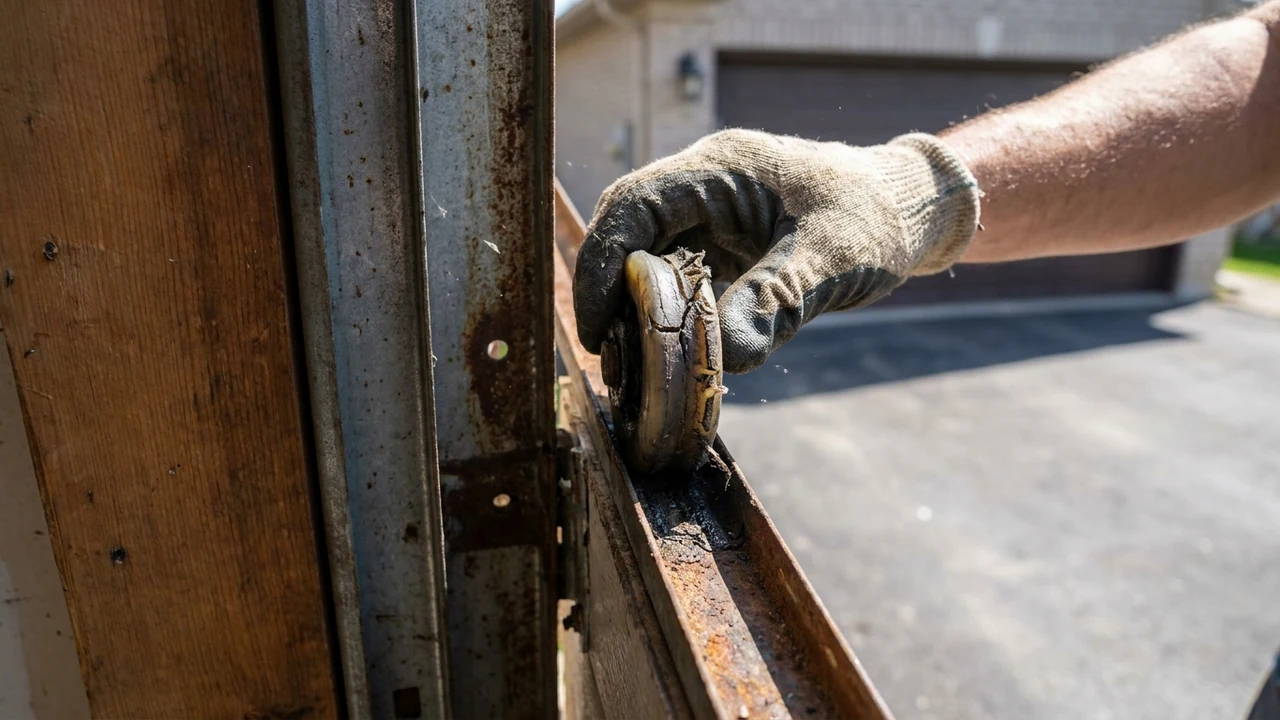
- Visible wear on the wheel itself — a nylon roller that's gone from round to flat-sided on one edge, or a steel roller with a wobble you can see when the door is moving slowly.
- A roller stem or wheel that looks different from the rest — check the ones you can see at the bottom of the door. If one looks worse than the other nine, that's your answer.
- The door drifting slightly off-centre in the track as it travels, even a few millimetres — a stressed or seizing roller is often the cause.
Any one of these on its own isn't an emergency. Two or three together, especially with the door still moving normally otherwise, is the point to get it looked at before a roller lets go mid-cycle.
What waiting actually costs you
A worn roller doesn't fail in isolation. As it seizes or wears down, the door starts to drag and bind in the track instead of gliding through it. That extra resistance gets absorbed somewhere — usually the opener motor, which works harder on every cycle, or the track itself, which can bend or pull away from its mounting as the door fights its way through. In the worst case, a roller that comes apart mid-cycle knocks the door off the track entirely.
That's the real reason to catch this early: roller replacement runs $120-$220. Track repair or realignment, which is often what you're looking at once a bad roller has been dragging for months, runs $180-$350, and a full off-track repair runs $180-$450. None of that is inevitable — it's what a $120 fix turns into when it's left long enough to become someone else's problem too.
A five-minute check you can do yourself
You don't need to take anything apart to get a read on your rollers.
- Run the door through one full cycle with the car out of the way, and just listen. New or worsening grinding, especially localized to one or two points in the travel, points to a specific bad roller rather than general wear.
- Look at the bottom rollers with the door closed — they're the easiest and safest ones to see without touching anything. Check for flat spots, cracks, or a wheel that's visibly loose on its stem.
- Watch the door's edge against the track as it travels. Steady and centred is normal. Any wobble or a visible gap opening and closing is worth a second opinion.
Leave the top rollers alone. They sit near the top bracket under the tension of the spring system, and replacing them safely means understanding how the door is supported while it's off that roller — that's the point where it becomes a technician job rather than a weekend project, the same way spring work is.
What roller replacement actually involves
Full roller replacement means swapping every roller on the door — usually eight to ten on a standard 7-foot sectional door — rather than just the one or two that are audibly bad. There's very little added labour to do the rest while the door is already apart, and it means you're not booking a second visit in a year or two for the roller sitting next to the one that just failed. At $120-$220, the job typically includes the rollers, the labour, and a check of the track and hinges while everything's accessible, since a roller that failed from friction is often a sign the track alignment played a part too.
Royal Garage Doors recommendation
Rollers are one of the cheapest parts on the door and one of the easiest to ignore, right up until a bad one takes the track or the opener down with it. If your door has gotten louder over the past year, hesitates at the same spot every cycle, or you can see wear on the bottom rollers, get it looked at before it turns into a bigger repair. Royal Garage Doors has been servicing garage doors across Mississauga, Etobicoke, and the GTA, with customer feedback on our Etobicoke Google profile, and the service call is free with any repair. See current rates on our pricing page, or book a roller replacement directly online.
Related reading: Garage Door Track Lubrication: What to Use and What to Avoid.
Frequently Asked Questions
How do I know if my garage door rollers need replacing?
Listen and watch. Grinding or squealing that lubrication doesn't fix, a door that shudders or hesitates at the same point every cycle, or rollers you can see are cracked, flat-sided, or visibly worse than the rest are all signs. If the door has started drifting slightly in the track, don't wait — that's usually a roller close to failing.
Can I replace garage door rollers myself?
The bottom rollers are manageable for a confident DIYer once you can see they're worn. The top rollers sit near the top bracket under the tension of the spring system, and replacing them safely means understanding how the door is supported while it's off that roller — that's the point where most homeowners call a technician rather than risk the door coming off the track.
Do all the rollers need to be replaced at once, or just the worn ones?
You can replace individual rollers as they fail, but if the door's been in service for years, the rest are usually close behind on cycle count. Most technicians recommend replacing the full set at once — it's very little added labour, and it means you're not paying for a second visit when the roller next to it fails a year later.
Will worn rollers damage other parts of the garage door?
Yes, and that's the real cost of waiting. Worn rollers make the door bind and drag in the track, which puts extra strain on the opener motor and the track alignment. A roller that seizes or comes apart can knock the door off-track entirely, turning a $120-$220 roller job into a $180-$450 track repair.
How much does garage door roller replacement cost in the GTA?
Royal Garage Doors prices roller replacement at $120 to $220, depending on the number of rollers and whether nylon or steel is used. The service call itself is free with any repair, and the job is usually done in under an hour.
Sources & standards: Garage door safety follows the UL 325 standard for automatic operators. For safe manual operation, see Chamberlain's emergency-release guidance. Pricing reflects current Royal Garage Doors rates for the GTA.
The bottom line: done right, the result is a garage door that opens quietly, balances correctly and is safe to use every day — backed by Royal's 1-year labour warranty so the outcome lasts.