How to Silence a Squeaky Garage Door Hinge

Royal Garage Doors has customer feedback on its Etobicoke Google profile and technicians with hands-on experience installing and repairing doors across Toronto and the wider GTA.
How do you silence a squeaky garage door hinge?
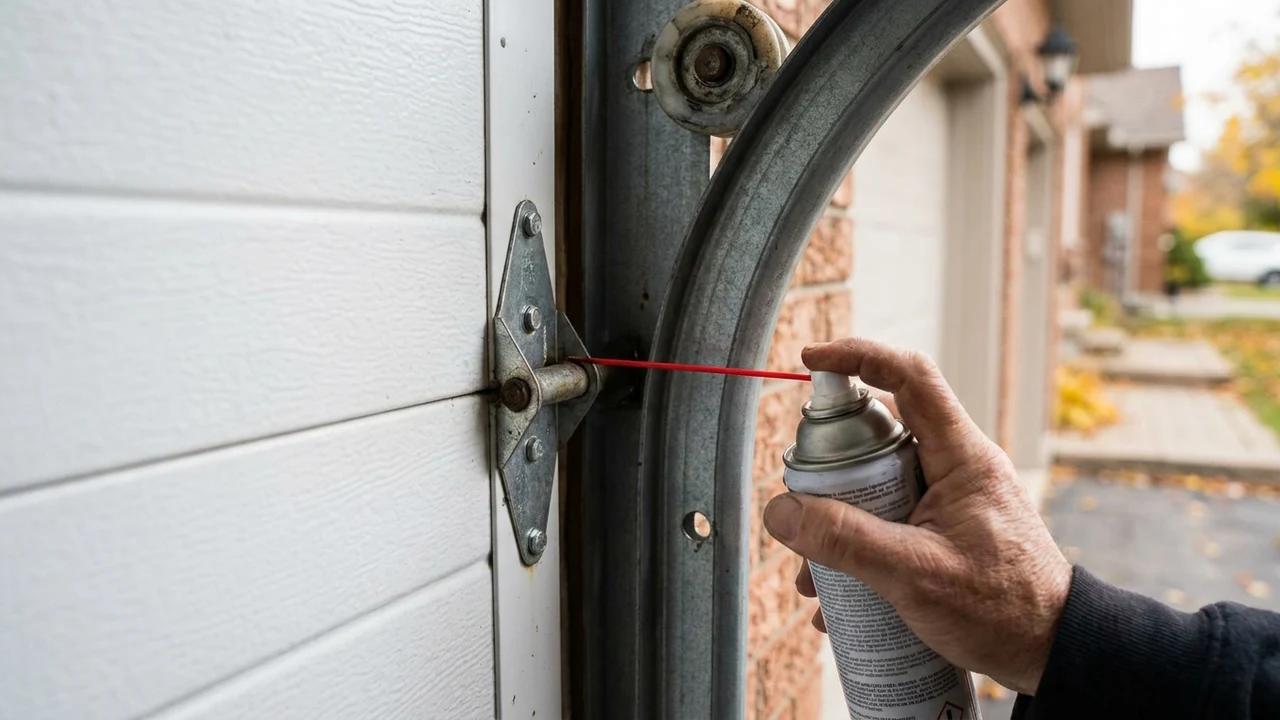
To silence a squeaky garage door hinge, wipe off rust and grit, then apply a silicone-based spray or white lithium grease to each pivot point — never WD-40, which evaporates and attracts dust.
What's the best lubricant for a squeaky garage door hinge?
A silicone-based garage door spray or white lithium grease made for door hardware. Both stay on the pivot instead of running off, resist dust the way oil-based products don't, and
- Customer feedback
- Read our Google reviews (Etobicoke profile)
- Experience
- Garage door service across the GTA
- Repair warranty
- 1-year parts and labour unless a specific written warranty overrides it
- Author
- Royal Garage Doors, Garage door repair and installation
The squeak is almost always coming from the hinges, not the rollers
A sectional garage door is built from three or four stiff panels connected by hinges that let the door bend as it travels from vertical, up the wall, to horizontal, along the ceiling track. Each hinge has a pivot point — the small barrel where two hinge leaves overlap and a pin holds them together — and that pivot flexes every single time the door opens or closes. That repeated metal-on-metal flexing, not the wheels, is where a squeak almost always starts.
Rollers can squeak too, but it sounds different and it happens differently. A dry roller bearing produces a steady, higher-pitched whine that runs the whole time the door is moving. A hinge squeak is more of a sharp creak or chirp that happens at specific points in the door's travel, usually right as a panel works through the curved section of track where the hinge has to flex the hardest.
| Hinge squeak | Roller squeak | |
|---|---|---|
| Sound | Sharp creak or chirp | Steady, higher-pitched whine |
| When it happens | At specific points in travel, usually the curved track section | Continuously while the door is moving |
| Source | Dry pivot where two hinge leaves meet | Dry wheel bearing spinning in the track |
| Fix | Silicone or white lithium lubricant on the pivot | Lubricant on the stem; worn nylon rollers may need replacing ($120–$220) |
Hinges #2 and #3 do most of the work — and most of the squeaking
On a standard 4- or 5-section door, hinges are numbered from the bottom up. The bottom section usually rides on brackets rather than a true hinge, and the top section is fixed directly to the strut behind the top panel. The hinges in between, typically the ones numbered 2 and 3, are the ones that pass through the curved transition in the track on every single cycle, so they carry far more flex and far more wear than the end hinges over the life of the door. Run the door slowly with the garage quiet and you can usually point to almost exactly where the squeak happens on each side — that's your hinge, and it's very rarely all four or five squeaking at once.
Clean before you lubricate
Spraying lubricant onto a hinge that's caked with rust dust, old grease, and driveway grit doesn't quiet it down — it just turns dry grinding into wet grinding, which can sound worse than the original squeak. Wipe each hinge pivot with a rag first. If there's visible rust or a crusty buildup around the pin, work it off with a wire brush or fine steel wool before applying anything new.
Use a silicone-based spray, not WD-40
This is where most homeowners get it wrong. WD-40 is a solvent and light degreaser, not a long-term lubricant — it's genuinely useful for breaking a seized hinge free, but it evaporates within days and leaves the pivot dry again, often squeakier than before because it stripped away whatever grease was left in the joint. Motor oil and household 3-in-1 oil have the opposite problem: they're too thin, they run off the hinge onto the panel, and they attract dust and grit that turns into a grinding paste over a few weeks.
What actually works long-term is a silicone-based garage door lubricant or a white lithium grease made for door hardware. Both stay put on the pivot instead of dripping, don't pull in dirt the way oil does, and hold up through a GTA winter without stiffening up the way heavier grease can in the cold. Apply a light coat to the pivot point of every hinge — not the panel face, not the track — plus the roller stems and the opener's chain or belt while the can is out. Run the door up and down two or three full cycles to work the lubricant into each pivot, then wipe off anything that dripped onto the panel or floor.
When lubrication doesn't fix it
If a hinge is still squeaking, grinding, or squealing after a proper cleaning and lubrication, or if it quiets down for a week and comes right back, stop treating it as a lubrication problem and start looking at the hardware itself. A few things point to a hinge that needs replacing rather than more oil:
- A visible crack in the hinge leaf — usually starting at one of the mounting screw holes, where stress concentrates every time the door cycles.
- Elongated, oval-shaped pivot holes instead of round ones — a sign the pin has been wearing against soft, fatigued metal for a long time.
- Rust that's eaten into the metal rather than sitting on top of it — you'll feel pitting or flaking under your fingers, not a smooth painted surface.
- Visible wobble or play in the hinge when the door is stopped mid-travel, or a panel that looks slightly twisted or sagging right at that joint.
A cracked or badly worn hinge isn't just noisy — it's a piece of hardware that can let a panel torque out of alignment or pull loose from the track under the door's own weight, especially on a wider double door where each hinge carries more load. That's a hardware repair, not a maintenance task, and it's worth having a technician look at it rather than keep lubricating around a crack that's only going to grow.
How often to lubricate so hinges don't start squeaking again
Hinges, rollers, and the opener chain or belt should get lubricated about twice a year — once heading into winter and once in spring, after a season of road salt and grit has had time to work into the hardware. If you're already booking a spring or fall tune-up, ask for hinge lubrication as part of it: Royal Garage Doors' maintenance package covers lubrication, a balance check, safety sensor alignment, and hardware tightening for $120 + tax, and it's the easiest way to catch a hairline crack or a loosening bracket before it turns into the squeak you can hear from the driveway.
Royal Garage Doors recommendation
A squeaky hinge on its own is rarely an emergency. Clean it, lubricate it with a silicone-based or white lithium product on the pivot, and it should quiet down within a cycle or two. What we look for on service calls is a hinge that's been squeaking for months and has started to show a crack, an elongated pivot hole, or a panel that sits slightly crooked at that joint — that's hardware wear, and it's worth catching before a panel torques or the door comes off its track.
Royal Garage Doors has been servicing garage doors across Mississauga, Toronto, and the GTA, with customer feedback on our Etobicoke Google profile. The service call is free with any repair, and a full hinge, roller, and bracket check is part of every maintenance visit. See current rates on our pricing page, or book a maintenance or repair visit and we'll check every hinge on the door while we're there.
Related reading: Garage Door Track Lubrication: What to Use and What to Avoid.
Frequently Asked Questions
What's the best lubricant for a squeaky garage door hinge?
A silicone-based garage door spray or white lithium grease made for door hardware. Both stay on the pivot instead of running off, resist dust the way oil-based products don't, and hold up through a GTA winter. Avoid WD-40 for anything beyond freeing a stuck hinge — it evaporates in days.
How can I tell if it's the hinge or the roller that's squeaking?
A hinge squeak is a sharp creak or chirp that happens at specific points in the door's travel, usually where the track curves. A roller squeak is a steady, higher-pitched whine that runs continuously while the door moves, coming from a dry wheel bearing.
How often should garage door hinges be lubricated?
About twice a year — once in spring and once heading into winter — along with the rollers and the opener chain or belt. Royal Garage Doors' $120 maintenance package covers lubrication, a balance check, and hardware tightening in one visit.
Can a squeaky hinge mean my garage door is about to fail?
Usually not on its own. But if the squeak persists after cleaning and lubrication, and you see a crack in the hinge leaf, an oval-shaped pivot hole, or a panel sagging at that joint, that's hardware wear that should be inspected before it worsens.
Should I try to replace a garage door hinge myself?
Loosening hardware on a door under spring tension carries real risk, and a middle hinge sits close to the torsion spring system. If a hinge shows a crack or wobble, it's safer to have a technician replace it — the service call is free with any repair.
Sources & standards: Garage door safety follows the UL 325 standard for automatic operators. For safe manual operation, see Chamberlain's emergency-release guidance. Pricing reflects current Royal Garage Doors rates for the GTA.
The bottom line: done right, the result is a garage door that opens quietly, balances correctly and is safe to use every day — backed by Royal's 1-year labour warranty so the outcome lasts.