Why Your Garage Door Has a Gap at the Bottom Corner

Royal Garage Doors has customer feedback on its Etobicoke Google profile and technicians with hands-on experience installing and repairing doors across Toronto and the wider GTA.
Why does my garage door have a gap at one bottom corner?
A gap at one bottom corner of your garage door — not the whole width — usually isn't a seal problem. It means the door isn't sitting level: a settled concrete floor, a bent track pulling that side out of plane, or uneven cable or spring tension is holding one corner up.
Why is there a gap only on one side of my garage door, not the whole bottom?
A gap on just one side means the door isn't closing level. The three most common causes are a settled or uneven concrete floor under that side of the opening,
- Customer feedback
- Read our Google reviews (Etobicoke profile)
- Experience
- Garage door service across the GTA
- Repair warranty
- 1-year parts and labour unless a specific written warranty overrides it
- Author
- Royal Garage Doors, Garage door repair and installation
A gap at one corner is a different problem than a worn seal
If the gap runs evenly along the entire bottom edge of the door, that's almost always a worn or compressed bottom seal — rubber flattens and shrinks over 6-8 years, especially after a few Ontario winters of road salt and freeze-thaw cycling. That's a straightforward fix.
A gap that's concentrated at one bottom corner — say a quarter inch on the left and a full inch or more on the right — is telling you something else: the door isn't closing level. Somewhere between the tracks, the cables, the springs, and the floor itself, one side is finishing higher than the other. Swapping the seal won't touch that; you'll just be buying a slightly thicker strip of rubber to plug a gap that will come back.
Check the floor before you touch the door
The first thing to rule out is the simplest: the concrete isn't level anymore. Garage slabs and driveway aprons settle unevenly over time, and it's common across the GTA on homes built over clay-heavy soil — we see it a lot in Brampton, Vaughan, and older sections of Etobicoke and North York where the apron was poured as a separate pour from the garage floor and the two have settled at different rates over 15-20 years.
Lay a level across the threshold, or just watch where the gap sits when the door is fully down. If the low corner is always the same side no matter how the door itself is adjusted, the floor — not the door — is the root cause. This matters because adjusting a perfectly good door to chase a sunk floor doesn't hold; the gap creeps back within a few months. A bulb-style or wraparound bottom seal can absorb a moderate floor dip better than a flat seal, but a genuinely sunk slab is a foundation-repair question, not a garage door one, and we'll tell you that honestly rather than keep re-adjusting a door that isn't the problem.
Sight down both tracks for a bend
Stand at the side of the door, outside the garage, and look down the length of each vertical track from bottom to top. A track that's been bumped — a car bumper backing in too far, a bike or ladder leaned against it, a snowblower clipping it in January — doesn't need to look dramatically damaged to throw the door off. Even a track bowed a few millimeters out of plane will pull that corner of the door away from the floor as it comes down, because the roller riding in that track is no longer tracking straight.
This is one of the more common causes we find on a corner-gap call, and it's also one of the easier ones to confirm: a bent track usually has a visible kink, and you'll often see a shiny wear mark on the inside of the track where the roller has been rubbing unevenly. Track repair and realignment runs $180-$350. If the door has actually jumped the track on that side at some point, it's an off-track repair instead, at $180-$450.
An uneven cable or a weak spring will tilt the door
The lift cables and torsion springs are what hold the door's weight evenly across both sides as it travels. When one side loses tension relative to the other, the door doesn't drop straight — it comes down slightly crooked, and that shows up as a bigger gap at whichever corner is finishing high.
Two common causes:
- A cable has slipped a wrap off the drum or started to fray. That side effectively has a few extra millimeters of slack, so it hangs lower or seats differently than the other. Cable and bracket repair runs $180-$260.
- One spring in a two-spring setup has weakened while the other is still near full strength. This is common when only one spring has failed and gets replaced on its own — the new spring and the old, fatigued one don't pull evenly, and the door leans as it travels. It's the reason we replace both springs as a matched set on a double-spring door ($320-$460) rather than swapping just the broken one; two springs of different ages almost never stay balanced for long.
How to check it yourself before booking a visit
A few minutes with a tape measure will tell you a lot:
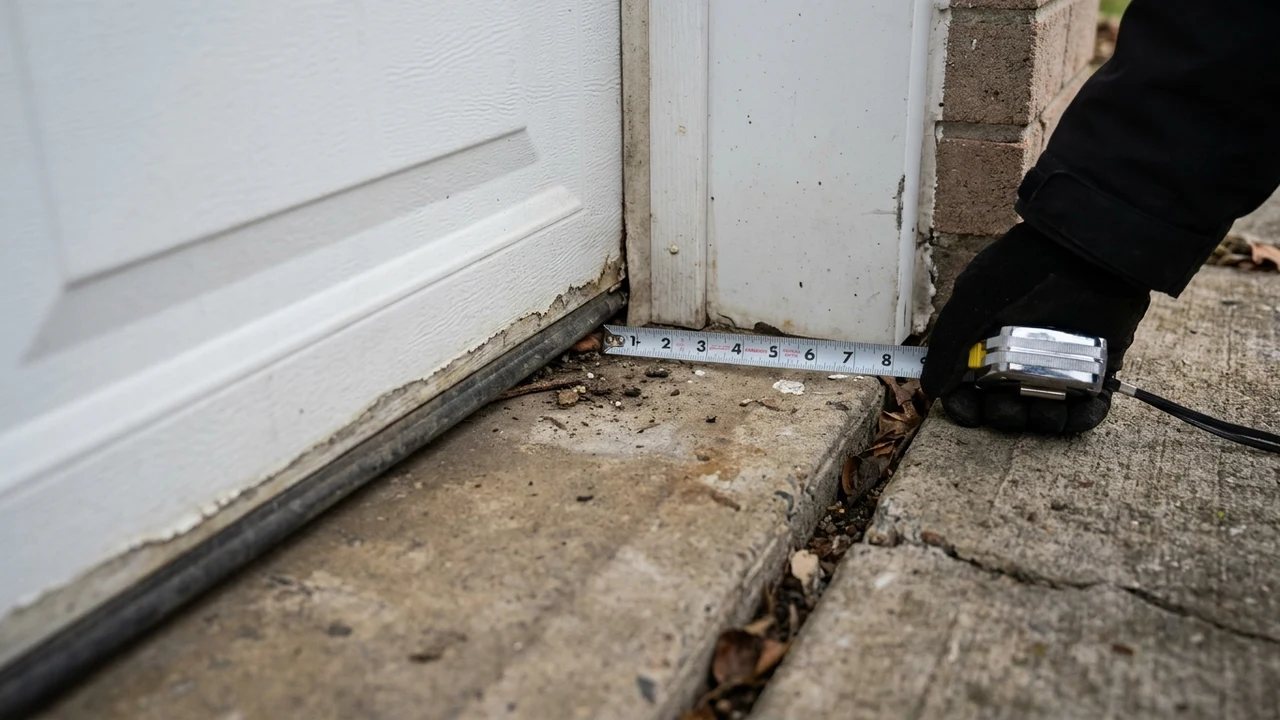
- Close the door fully and measure the gap at each bottom corner. Write both numbers down — you want to know if it's a small difference or a large one.
- Disconnect the opener (pull the manual release cord) and lift the door by hand about halfway. It should move smoothly and stay roughly where you leave it. If it drags, binds, or drops on one side specifically, that side has a mechanical problem, not just a leveling issue.
- Look for a shiny "rub mark" inside either track, a sign a roller has been riding off-center.
None of this requires opening a spring or touching anything under tension — leave that part to a technician. But knowing which side is low and whether the door moves evenly by hand will help whoever comes out diagnose it in one visit instead of two.
Quick reference: symptom to likely cause
| What you see | Likely cause | Typical fix |
|---|---|---|
| Gap even across the whole bottom edge | Worn or shrunk bottom seal | Weather stripping / bottom seal, $120-$260 |
| Gap at one corner, floor itself out of level | Settled or heaved concrete slab | Bulb-style seal to compensate; floor is a separate repair |
| Gap at one corner, visible bow or shine mark in the track | Bent or misaligned track | Track repair/realignment, $180-$350 |
| Door has come off the roller path on that side | Off-track | Off-track repair, $180-$450 |
| Door leans or drags to one side when moved by hand | Slipped/frayed cable or uneven spring tension | Cables & brackets $180-$260, or spring set $320-$460 |
Why forcing it down or shimming the seal doesn't hold
The two DIY fixes we see most often are bending the bottom bracket to force that corner lower, and buying a thicker or double-layer bottom seal to fill the gap. Both are worth avoiding. Bending a bracket changes how the cable sits in it and can put uneven load on that corner every time the door cycles, which tends to make the real problem — a bent track or an uneven cable — worse over a few months, not better. An oversized seal can also interfere with the opener's safety reversal sensors if it changes how much resistance the door meets on the way down, which is not something to guess at.
If your door is more than 10-12 years old and the corner gap has been there a while, it's also worth having the panel itself checked at that corner — repeated flexing against an uneven track can eventually warp or crease a steel panel, at which point panel replacement ($500-$1,000) is the more sensible fix than continuing to chase the alignment.
Royal Garage Doors recommendation
A gap at one bottom corner is a leveling problem, not a seal problem, and the fix depends entirely on which of three things is out of line: the floor, the track, or the cable/spring balance. Guessing wrong means paying for a seal twice. Our technicians bring a level and check the track alignment and cable tension on the same visit — the service call is free with any repair — so you get one diagnosis instead of a string of trial-and-error fixes. See current rates on our pricing page, or book a diagnostic visit and we'll tell you straight whether it's the track, the cables, or the floor underneath it.
Related reading: How to Clean and Maintain Garage Door Weatherstripping.
Frequently Asked Questions
Why is there a gap only on one side of my garage door, not the whole bottom?
A gap on just one side means the door isn't closing level. The three most common causes are a settled or uneven concrete floor under that side of the opening, a bent or misaligned vertical track pulling that corner out of plane, or a slipped/frayed cable or uneven spring tension letting one side hang lower than the other.
Will a new bottom seal fix a gap at one corner?
Usually not for long. A worn seal causes an even gap across the whole width. A one-corner gap is a leveling problem — a thicker seal may mask it temporarily, but the gap typically comes back within a few months because the underlying track, cable, or floor issue is still there.
How much does it cost to fix a bent garage door track?
Track repair and realignment runs $180-$350 with Royal Garage Doors. If the door has actually come off the roller path on that side, it's classified as an off-track repair instead, running $180-$450.
Can a settled concrete floor cause a garage door gap?
Yes. Garage slabs and driveway aprons settle unevenly over years, especially on clay-heavy soil common across parts of the GTA. If the low corner is always the same side regardless of how the door is adjusted, the floor is the likely cause, and a bulb-style seal that compensates for the dip is a better fix than repeatedly re-adjusting the door.
Is a crooked garage door dangerous?
It can become one over time. A door that closes unevenly puts uneven stress on the cables, rollers, and opener's force sensors, and can eventually warp a panel or affect how the safety reversal responds. It's worth having it checked rather than living with it, especially if the gap has been growing.
Sources & standards: Garage door safety follows the UL 325 standard for automatic operators. For safe manual operation, see Chamberlain's emergency-release guidance. Pricing reflects current Royal Garage Doors rates for the GTA.
The bottom line: done right, the result is a garage door that opens quietly, balances correctly and is safe to use every day — backed by Royal's 1-year labour warranty so the outcome lasts.