Why Your Garage Door Reverses the Instant It Touches the Floor

Royal Garage Doors has customer feedback on its Etobicoke Google profile and technicians with hands-on experience installing and repairing doors across Toronto and the wider GTA.
Why does my garage door reverse the instant it touches the floor?
When a garage door reverses the instant it touches the floor — not partway down, but right at contact — the opener's close-limit or force setting is misreading the floor as an obstruction, not a broken sensor.
Is a door that reverses at the floor the same problem as a bad safety sensor?
No. Safety sensors cause a door to stop or reverse mid-travel, before it ever reaches the floor, because the light beam between them is broken or misaligned. A door that
- Customer feedback
- Read our Google reviews (Etobicoke profile)
- Experience
- Garage door service across the GTA
- Repair warranty
- 1-year parts and labour unless a specific written warranty overrides it
- Author
- Royal Garage Doors, Garage door repair and installation
This isn't a sensor problem — it's happening in a different place
If your door reverses somewhere in the middle of closing, or refuses to close at all, that's almost always the photo-eye sensors — the two small units near the floor on each side of the track. But if the door closes normally, actually touches down, and then immediately kicks back open the instant it makes contact with the concrete, the sensors aren't the issue. The beam isn't broken; the door already reached the floor. What's tripping is the opener's force reversal system, and it's reading the floor itself as an obstruction.
This distinction matters because the fix is completely different. A dirty sensor lens gets wiped clean. A force setting that's fighting the floor needs an actual adjustment to the opener's limit and force settings — and in some cases, a mechanical repair to whatever is making the door harder to close than it used to be.
What "limit" and "force" actually control
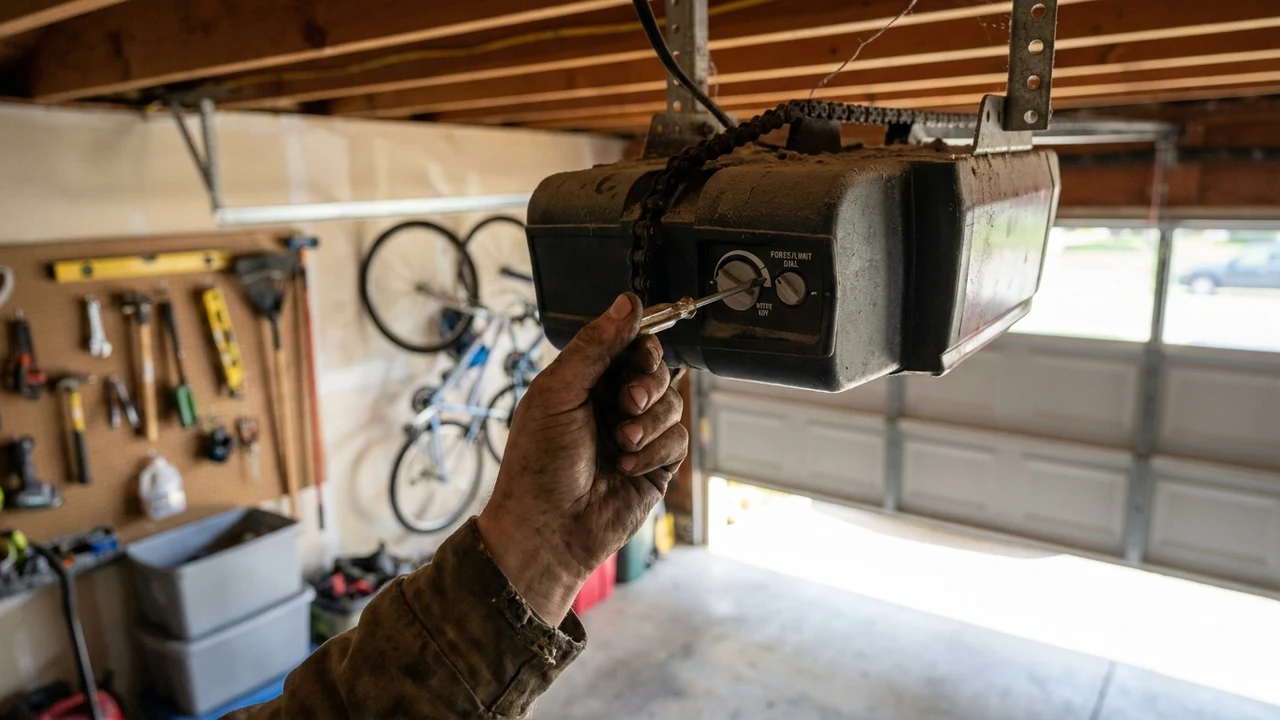
Every garage door opener has two settings that work together during the close cycle, whether they're set with small dials on the motor unit (common on chain-drive LiftMaster and Genie units) or through a wall console menu or the myQ app on newer belt-drive models:
- Close limit: how far down the opener drives the door before it decides the cycle is finished. This should be set so the door stops the instant the bottom seal makes contact with the floor — not before (leaves a gap) and not after (drives into the floor).
- Close force: how much resistance the motor will push against before it assumes it's hit something and reverses. This exists because of a federal safety standard (UL 325, in effect since 1993) requiring openers to stop and reverse rather than keep crushing whatever is under the door.
When the close limit is set even slightly too far — asking the door to travel a fraction of an inch past where the floor actually is — the opener keeps trying to push the door down after it's already sealed against the concrete. It can't go any lower, so resistance spikes immediately. The force sensor reads that spike exactly the way it's designed to: as an obstruction. The door reverses at the one point in the cycle where it's actually doing its job correctly, which is exactly why it feels backwards.
Why this shows up on an opener that used to work fine
Limit and force settings don't usually get touched again after installation, so when this starts happening on a door that's closed normally for years, something around it changed — not the opener's programming itself. In the GTA, the usual culprits are:
- The floor moved. Concrete garage slabs shift slightly over years of freeze-thaw cycles. A driveway apron or slab edge that's heaved even a few millimetres changes where "the floor" actually is relative to the opener's saved limit.
- The bottom seal was replaced with a thicker one. A fresh weather-stripping install (typically $120–$260 depending on door size) adds a few millimetres of material the door now has to compress against — enough to push the old limit setting past the new contact point.
- Spring tension has drifted. Torsion springs counterbalance the door's weight through its whole travel. If tension is off — even slightly — the opener works harder in the final foot of travel, right where it's trying to seat the door, and that extra effort can trip the force threshold.
- Rollers or track picked up resistance. Road salt and winter grime tend to collect at the bottom section of track, where it's most exposed. Stiff or worn rollers add friction specifically in the last stretch of travel — the same stretch where the limit and force settings are doing their work.
Telling the three reversal patterns apart
| Where it reverses | Likely cause | What to check first |
|---|---|---|
| Partway down, door never reaches the floor | Sensor beam blocked, dirty, or misaligned | Photo-eye LEDs, lens dirt, bracket alignment |
| Right at floor contact, every single time | Close limit set too far / force too sensitive | Limit and force dials, floor level, seal thickness |
| Random point, different each cycle | Worn rollers, loose track, slack chain | Track alignment, roller condition, chain/belt tension |
Adjusting the settings yourself
On most openers, the limit and force adjustments are two small dials or a labeled +/- button pair on the motor housing, usually under a small access panel. Newer smart openers put the same controls in the wall console or the app.
- Adjust the close limit first. Move it in small increments — a quarter turn at a time on dial-style units — and run a full close cycle after each change. You're looking for the door to stop the instant the seal contacts the floor, with no gap and no extra push.
- Only touch force if the reversal continues with a correct limit. Increase it in the smallest available step, then retest.
- Run the safety test after every change. Lay a piece of 2x4 or a rolled-up towel flat on the floor where the door closes. Run the cycle. The door must stop and reverse when it contacts the object. If it doesn't, the force is set too high and needs to come back down — that's not a setting to leave "a little aggressive" to stop nuisance reversals.
That last point is the one worth taking seriously. It's tempting to just keep cranking the force dial until the reversing stops, but the force setting exists specifically to stop a door from continuing to close on a pet, a foot, or a bike that's in the way. If your door needs progressively more force each season just to seal against the floor, that's a sign something mechanical is working against it — not a reason to raise the ceiling on how hard the opener is allowed to push.
When it's a mechanical problem wearing the disguise of a settings problem
If you've set the close limit correctly and the door still fights the last inch of travel, the resistance is coming from somewhere physical, and no amount of dial-turning fixes it for good:
- Springs out of adjustment — torsion springs store enough energy to cause serious injury if handled without the right tools. This is not a DIY adjustment; it's a technician call.
- Worn or stiff rollers — a straightforward swap, typically $120–$220.
- Track misalignment — realignment runs $180–$350; a fully off-track door is $180–$450.
- A drifting or failing force sensor in the opener itself — opener repair covers this at $120–$550 depending on what's actually wrong (gear kit, logic board, or the sensor circuit).
A quick way to tell which you're dealing with: after the limit is properly set, manually disconnect the opener (pull the red release cord) and lift the door by hand from about halfway down. If it gets noticeably harder to move in the last foot, or doesn't stay put when you let go, that's spring or track resistance — not a setting you can adjust your way out of.
Royal Garage Doors recommendation
A door that reverses the instant it touches down is one of the easier calls to make correctly, because the pattern itself tells you where to look: at the floor, not the sensors. If a careful limit adjustment and the 2x4 safety test don't fully resolve it, that's your sign the resistance is mechanical — springs, rollers, or track — and worth having checked properly rather than compensated for with a higher force setting. Royal Garage Doors has been doing exactly this kind of diagnostic across the GTA, with customer feedback on our Etobicoke Google profile, and the service call is free with any repair. See current rates on our pricing page, or book a visit and we'll get the limit, force, and whatever's behind it sorted in one trip.
Related reading: How to Adjust Garage Door Opener Travel Limits.
Frequently Asked Questions
Is a door that reverses at the floor the same problem as a bad safety sensor?
No. Safety sensors cause a door to stop or reverse mid-travel, before it ever reaches the floor, because the light beam between them is broken or misaligned. A door that closes fully, touches the floor, and reverses right at contact has already passed the sensors — the issue is the opener's close-limit or force setting reading floor contact itself as resistance.
Can I adjust the limit and force settings myself?
On most openers, yes — they're small dials or +/- buttons on the motor unit, or menu settings in the app on newer smart openers. Adjust the close limit first in small increments until the door stops right at floor contact, then run the 2x4-on-the-floor safety test after every change to confirm the door still reverses properly on an obstruction.
Why did this start happening after years of the door working fine?
The opener's settings rarely change on their own — something around them shifted instead. Common causes in the GTA include a concrete slab moving slightly from freeze-thaw cycles, a new bottom seal that's thicker than the old one, spring tension drifting out of balance, or rollers and track picking up resistance from winter road salt.
Is it safe to just increase the force setting until the door stops reversing?
No. The force setting is a federally mandated safety feature (UL 325, since 1993) that stops the door from continuing to close on a person, pet, or object. If you have to keep raising it to stop nuisance reversals, that usually means something mechanical is adding resistance — the fix is addressing that resistance, not raising the force ceiling past what the 2x4 safety test allows.
When should I call a technician instead of adjusting it myself?
Call a technician if the limit setting keeps drifting back after you correct it, if the door needs noticeably more force to move by hand partway through its travel, or if you can see worn rollers or misaligned track. Spring tension issues in particular should never be adjusted without the right tools — torsion springs store enough energy to cause serious injury.
Sources & standards: Garage door safety follows the UL 325 standard for automatic operators. For safe manual operation, see Chamberlain's emergency-release guidance. Pricing reflects current Royal Garage Doors rates for the GTA.
The bottom line: done right, the result is a garage door that opens quietly, balances correctly and is safe to use every day — backed by Royal's 1-year labour warranty so the outcome lasts.